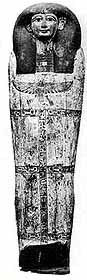
Tuthmosis II was pharaoh during the 18th Dynasty. While the length of his reign is constantly in dispute, he was the immediate successor of his father Thutmose I. Tuthmosis II's rule was relatively short and is estimated to be 1512 B.C.E. - 1503 B.C.E. (Oxford History states 1492 B.C.E. - 1479 B.C.E. while the Chronicle of the Paraohs 1518 B.C.E. - 1504 B.C.E.). Had his two older brothers, Wadjmose and Amenmose, not died, Tuthmosis II would not have become pharaoh. the eldest sons of Tuthmosis I, leaving him as the only heir. The eldest son of Mutnefert, a minor royal queen, Tuthmosis II died in his early thirties. His throne name was A-kheper-en-re, which means "Great is the Form of Re."
Family
Tuthmosis II was married to Hatshepsut, his half-sister. Marrying within the family was not uncommon among the royal families as royal blood was thought to run through the women. Because of the frequency of the intermarrying Tuthmosis II himself was both physically and mentally weak.
Tuthmosis II had one son by a minor wife, Iset, who would be his heir, Tuthmosis III. Tuthmosis would not see the throne until his step-mother's death. Tuthmosis II had two daughters by Hatshepsut, but she bore him no sons. Tuthmosis II say his wife's ambitions and attempted to secure his son's reign, but Tuthmosis III was still too young when Tuthmosis II died. Hatshepsut took the advantage and named herself as regent, and then taking on the full regalia of the pharaoh.
Impacts
Tuthmosis II was able preserved his father's, Tuthmosis I, empire with two campaigns. In the first year of his reign Tuthmosis II crushed a revolt in Nubia and later he led a campaign against the Shosu Bedouin of southern Palestine who were also threatening the peace. Testiments of his campaigns are inscripted in the temple at Deir el-Bahari and a rock-cut stele at Sehel south of Aswan.
Tuthmosis II's building projects included traces of a temple just north of the temple of Medinet Habu on the West Bank at Luxor (aka, Thebes). This temple is known as Shespet-ankh, Chapel of Life, and was finished by Tuthmosis III. Tuthmosis II also built a pylon shaped limestone gateway in front of the Fourth Pylons forecourt at Karnak (which also had to be completed by Tuthmosis III). Scenes on the gate depict Tuthmosis II with Hatshepsut, sometimes Hatshepsut alone, Tuthmosis II is shown receiving crowns, and his daughter, Nefrure and wife, Hatshepsut receiving life from the gods.
Death 
Upon his early death, Tuthmosis II's son Tuthmosis III was too young to rule and Hatshepsut took over as regent. Tuthmosis II's mummy was found in a royal cache of mummies at Deir el-Bahari above Hatshepsut's Mortuary Temple in 1881 along with 39 other mummies. He had been interred along with other 18th and 19th dynasty leaders including Ahmose I, Amenhotep I, Tuthmosis I, Tuthmosis III, Ramses I, Seti I, Ramses II, and Ramses IX, as well as the 21st dynasty pharaohs Psusennes I, Psusennes II, and Siamun. His mummy can now be seen at the Egyptian Museum in Cairo. His original tomb which should have been in the Valley of the Kings has yet to be found. Tuthmosis II's mummy was unwrapped by Gaston Maspero on July 1, 1886, who said that "He [Tuthmosis II] had scarcely reached the age of thirty when he fell a victim to a disease of which the process of embalming could not remove the traces. The skin is scabrous in patches, and covered with scars, while the upper part of the skull is bald; the body is thin and somewhat shrunken, and appears to have lacked vigour and muscular power."

 Ancient Egypt 101 was created by the co-founder of TwilightBlog.net after experiencing how to own and operate a website. Egypt has always been her first love and hence the forging ahead for the ultimate goal of a Ph.D. in Egyptology at the University of Memphis. Ancient Egypt 101 was founded on the idea and desire to provide a well balanced look at Ancient Egypt to all people, especially those in a teaching capacity. Tools, videos, suggestions, and basic information are all provided on the site to provide a foundation and starting point. "Excessive" detail is not given on the site for sake that you explore Egypt on your own for that detail in a book by a professional.