15 June 2009

Religion and Magic in Ancient Egypt

Religion and Magic in Ancient Egypt by Rosalie David

This is a very intense book and doesn't short you on any information.  However, it isn't written to entertain or please-it is straight facts.  So while it may not be a story line format you can't complain about the wealth of detail.  This is a great book that takes the divided periods of ancient Egyptian history and has a lengthy chapter on each that covers history, religion, developments, culture changes, and anything that could possible have helped or did shape the religion of the Egyptians.  There are also two large sections containing photos of some of the main people, artifacts, and buildings discussed within the text.  This book is a great read for people either already knowing their Egyptian history or for those who need some information just on a certain time period.  I suggest using this book as you go through the periods of Egyptian history, not just a straight read.  The reason I suggest both of these ways of using the book is because if you can't keep up you'll be lost within half a page.  If you have no previous knowledge that has good grounding you will not be able to just do a straight read.  But if you use it as sections it makes a great almost text-book!

14 June 2009

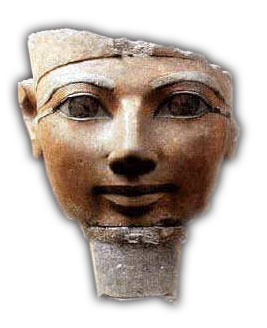
Hatshepsut

Hatshepsut is one of the most well known female rulers of Egypt.  Ruler in the 18th dynasty, Hatshepsut, meaning Foremost of Noble Women, became pharaoh when her two brothers died leaving her as her father's heir.  To have a female pharaoh was unprecedented, and probably most definitely unheard of as well.   Hatshepsut managed to rule Egypt for about twenty years, just before disappearing from history which coincided with "her" son Thuthmose III becoming pharaoh in his own right.

Family

Hatshepsut was the daughter of pharaoh Tuthmose I and his chief wife Aahmes.  She was the favorite of their three children.  When Tuthmose I died, his son Tuthmose II ascended the throne, but for the few years of his reign, Hatshepsut seems to have held the reins.  Upon his death, Hatshepsut, his half sister and wife, had produced only a daughter, Neferura, and Tuthmose II had sired a son through the commoner Isis.  

Impacts

Upon Tuthmose II's death his son, Tuthmose III, was in line for the throne, but due to his young age Hatshepsut was allowed to reign as queen dowager.  The pair "ruled" together for years until Hatshepsut finally proclaimed herself Pharaoh (it is assumed that she did this when Thuthmose III was reaching manhood).  This was unheard of, even with the higher status of women in Egypt compared to women in other cultures at the time.  However, before Hatshepsut, there were queens who had ruled Egypt, but none were a female Pharaoh.

Hatshepsut had many obstacles to overcome. The threat of revolt was always present, especially as her bitter nephew came of age.  She had to use propaganda and keen political skills.  Hatshepsut dressed in the traditional garb of male rulers: the shendyt kilt, the nemes headdress with its uraeus and khat head cloth, and the false beard.  Hatshepsut fought no wars during her reign.  Instead, she ordered expeditions to the land of Punt (present-day Somalia) in search of the ivory, animals, spices, gold and aromatic trees that Egyptians coveted. Hatshepsut emphasized not only her relationship to Tuthmose I her father, but her favor as having, as she claimed, to have been handpicked by her father above her two brothers.  Her last effort to be recognized as a legitimate Pharaoh, Hatshepsut constructed a fabulous temple in the Valley of the Kings by a tall plateau at Deir-el-Bahri, across the Nile from Thebes.  To keep control of the Egyptian empire for nearly 20 years Hatshepsut indeed was a master politician and an elegant stateswoman with total charisma.  

As Tuthmose III grew Hatshepsut's sovereignty grew tenuous.  Whether Tuthmose III killed Hatshepsut and Senmut (Hatshepsut's consort) is questionable but likely. Since he paid little respect to her in death, it is quite possible he paid even less in life.  But no matter how she died, we do know that she just disappear from history.

Death

The death of Hatshepsut remains a mystery.  Hatshepsut died, either as she was approaching or just entering middle age, and no record of her cause of death has survived.  It is believed that the hatred for his stepmother pushed Tuthmose III to erase her memory, existence, and any depictions of Hatshepsut by destroying any monuments erected during her reign.  While her temple still stands, her tomb nor her mummy have been found.   One of Hatshepsut's canopic jars was found, the one containing her liver. 

The recent identification of mummy in KV60 shows through CT scans indicate that the mummy died of metastatic bone cancer in the 50s.  In March 2006, Dr. Zahi Hawass claimed that this mummy was Hatshepsut, which was mislaid on the third floor of the Cairo Museum.  But in 2007 it was announced that Egyptologists believe they have identified Hatshepsut's mummy in the Valley of the Kings.  The decisive evidence was a molar in a wooden box inscribed with Hatshepsut's name.  It was found in 1881 in a cache of royal mummies hidden away for safekeeping in a near-by temple.

13 June 2009

Recommended Reading for Youth/Adults

What Life Was Like On the Banks of the Nile by Time-Life Books
-A beautifully detailed book of ancient Egyptian culture including marriage, coming of age customs, and religious beliefs and rituals.  Time is also spent on pharaohs in general and their power, belief in the afterlife, and tomb significance.

Egypt: Splendors of an Ancient Civilization by Alberto Siliotti
-Similar to a mass picture book for the "older" crowd with mass amounts of information on Egyptian geography, history, temples, and tombs.  Very visual dynamic for those who are visual and need to see an equivalent to what they are reading.

Ancient Egypt by Lorna Oakes & Lucia Gahlin
-This is an incredible book that mimics an encyclopedia.  A wealth of information of almost anything you could imagine.  This is one of my favorite books, I can read it straig
ht through or use it as a reference.  My pages are getting worn and torn with this book because I always consult this one.

Conversations with Mummies by Rosalie David and Rick Archbold
-This book is fascinating.  It looks at the ancient Egyptians via the mummies they left behind.  Understand what techniques they used in mummification, significance involved with mummification, and the science behind it all.

Tutankhamin: The Exodus Conspiracy by Andrew Collins and Chris Ogilvie-Herald
-The book is a fun read and provides some more in depth knowledge about the boy king.  However, the content is a bit extremist and nor do I agree with it all.  It is just one point of view.  Since the release of the book new evidence has come to light about the "wounds" found on the young king.

The Search for Nefertiti by Dr. Joann Fletcher
-While this is another fascinating topic, this book is not an easy ready.  A pretty substantial knowledge of Egypt is already needed to keep up the deep diggings of the author.  While well written, it is just so over whelming to people just beginning to study ancient Egypt.

The Hebrew Pharaohs of Egypt by Ahmed Osman
-This book was a delight to read.  This man's take on Biblical history and intertwining with what we know of Egyptian history was great.  While I agree with almost everything thing presented I think he does have a few fallacies throughout his logic.  However, the main idea he is presenting is fabulous!

Ancient Egypt by David P. Silverman, General Editor
-A mini-type of encyclopedia the book offers handfuls of facts ranging from the dynasties, to warfare history, culture, women in Egypt, and the culture and rituals surrounding the Egyptian religion.

Religion and Magic in Ancient Egypt by Rosalie David
-This book is extremely through and intense.  I would not recommend this one just to read and learn about Egypt.  Instead, if you want to learn some more about the religion during a period in ancient Egypt read the appropriate chapter.  Otherwise, you might get to bogged down and lose interest.

11 June 2009

Nefertiti

Nefertiti is perhaps of the most well known ancient Egyptians.  Made famous by her painted limestone bust (which is now in Berlin's Egyptian Museum, shown) it was found in the workshop of the famed sculptor Thutmose.  Moreover, the bust is believed to be the sculptor's model, not just an original, signifying that more were being made.

Nefertiti was the chief wife of Pharaoh Amenhotep IV (or Akhenaten).   Roughly translated her name means "the beautiful one is come."   She was famed throughout the ancient world for her outstanding beauty and perhaps more with her renown as always being by her husbands side.

Family

Nefertiti's origins are confusing and vague.   Suggestions range from that Tiy was her mother (along with her husband, Akhenaten) to that Nefertiti was Akhenaten's cousin.  Nefertiti's wet nurse was the wife of the vizier Ay who sometimes called himself "the God's father." (which could suggest that he might have been Akhenaten's father-in-law and therefore Nefertiti's father)  However, Ay never specifically refers to himself as the father of Nefertiti even with Nefertiti's sister, Mutnojme, prominently featured in the decorations of his tomb.   Nevertheless, Nefertiti may have also been a descendant of Ahmose-Nefertari, though she was never described as God's wife of Amun.  Also, she never lays claim to the title of King's Daughter, so we do know that she could not have been an heiress in the direct line of descent.

Impacts

Nefertiti had probably the largest impact of any ancient Egyptian female in history.  While it is almost agreed upon that she never actually ruled Egypt, she did not need to.  In fact, it looks like she ruled through her husband, Akhenaten.   In their religion that they established, the worship of the Aten, she was a priest.  Together the pair asserted that it was only through them combined that the full blessing of god Aten could be bestowed.  In accordance with the new religion Nefertiti changed her full name to  Neferneferuaten-Nefertiti or 'The Aten is radiant because the-beautiful one has come" or '"Perfect One of the Aten's Perfection."

In artwork, her status is evident and indicates that she had almost as much influence as her husband. For example, she is depicted nearly twice as often in reliefs as her husband, at least during the first five years of his reign. Indeed, she is once even shown in the conventional pose of a pharaoh smiting his/her enemy. 

Towards the end of Akhenaten's reign, Nefertiti disappeared from historical Egyptian records.  It is possible that Nefertiti's disappearance a number of years after that of Kiya's (who is believed for have born Akhenaten a son) simply meant that she died around the age of thirty.  However, there are controversies on this matter as well.  It may not be just a coincidence that shortly after 

Nefertiti's disappearance Akhenaten took on a co-regent.  This co-regent has been the subject of mass speculation and controversy.  One theory says that the co-regent was Nefertiti herself in a new guise, becoming a female king following the lead of women such as Sobkneferu and Hatshepsut.  Another theory is that there were actually two co-regents, consisting of Smenkhkare and Nefertiti, under the name Neferneferuaten, both of whom adopted the prenomen, Ankhkheperure.

Scholar Jacobus Van Dijk is adamant about Nefertiti assuming the role of co-regent and even serving as king for a short time after the death of Akhenaten.  He believes that Nefertiti became co-regent with her husband with her role as queen consort was taken over by her eldest daughter, Meryetaten (Meritaten).  He also suggests that Smenkhkare might have also been Nefertiti ruling after the death of her husband. 

Death

Nefertiti's tomb was never completed and no mummy was ever found.  But in June of 2003 archaeologist Joann Fletcher, from the University of York in England, announced that Nefertiti's mummy may have been one found in the famous cache of mummies in tomb KV35 in the Valley of the Kings.  If this really is Nefertiti then the evidence also suggests that Nefertiti was in fact the Pharaoh Smenkhkare.

The mummy was examined and was discovered to have been damaged in a way that suggested the body had been desecrated either at the time of death or shortly after.  Mummification techniques suggest an 18th dynasty royal mummy, the presence of embedded nefer beads, the age of the body, the arm had been buried in the position reserved for pharaohs, and the rare wig style worn by Nefertiti.  Later in 2003 Egyptian expert Zahi Hawass, head of Egypt's Supreme Council for Antiquities, dismissed the claim, citing insufficient evidence and was quoted as saying, "I'm sure that this mummy is not a female."

10 June 2009

Recommended Videos

Here is a list of videos that we recommend for anyone to watch whether for fun or to learn about Egypt:

Egypt: Rediscovering A Lost World by BBC
-The BBC's unique style of dramatization brings ancient Egypt to life like never before! Take an action-packed trip back in time and re-live ancient Egypt through the eyes of three of it's greatest explorers. The ancient past and the recent past are skillfully interwoven, merging drama with documentary, as brave 19th and 20th century adventurers, explorers and code-breakers risk everything to unveil the world of ancient Egypt. As their discoveries unfold, the tales of Tutankhamen and Ramses II are brought to life in this breathtaking production.

Ancient Egypt Unearthed by the Discovery Channel
 -For more than three thousand years its wealth and magnificence were unrivaled...and then lost to the desert sands. Now take a marvelous journey down the mighty Nile and back through time as we uncover many of ancient Egypt's long-lost mysteries. It's all h
ere - pyramids and temples, pharaohs and mummies - in this fascinating collection that explores one of the greatest cultures the world has ever known. 

Disc 1: Egypt Uncovered In five revealing episodes, world-renowned Egyptologists employ the latest technology and modern archaeological findings to breathe life into one of history's most fascinating cultures. A startling new picture emerges of the civilization that dominated the world for millennia. 

Disc 2: Egypt's Ten Greatest Discoveries Egypt's preeminent archaeologist, Zahi Hawass, and his team have selected the ten most important discoveries in Egypt. From major battles, to mega-construction, these discoveries reveal the amazing stories of the lives of kings, queens and ordinary people. Secrets of Egypt's Lost Queen More powerful than Cleopatra or Nefertiti, Hatshepsut was Egypt's greatest female ruler...and then she disappeared. Dr. Zahi Hawass investigates several mummies, one of which may well be the remains of this powerful queen. 

Egypt's Golden Empire by PBS
-In 1570 B.C., Rome was a marsh, the Acropolis an empty rock, but Egypt was 1,000 years old. The pyramid-builders were gone, yet Egypt still awaited its New Kingdom, an empire forged by conquest and remembered for eons. EGYPT'S GOLDEN EMPIRE comes to life through letters and records evoking the passion and riches of a time when Egypt was the center of the known world, its Pharaohs called gods, and great cities, temples and tombs built.

The Real Tomb Hunters by The History Channel
-This cool video is not limited to only the archaeologists that dig deep into Egyptian history.  In fact, it starts with the beginning of archeology itself to modern times.  Taking you through Egypt, China, South America, and Crete you get to see what the life of numerous famous archaeologists were and are like and were some of the ideas in movies such as Indian Jones come from.

04 June 2009

Recommended Reading for Kids

Egyptology by Emily Sands
-Join Emily Sands' expedition to find the lost tomb of Osiris. A jeweled amulet glows on the cover, inside the book, there are fold-out maps, postcards, drawings and photographs, ticket stubs, mummy cloth, a scrap of papyrus. "The pyramids reminded me of all I came to Egypt to discover – the dusty tombs, the ornate temples, the golden treasures." [excerpt]

Tutankamun: The Mystery of the Boy King by Zahi Hawass
-Journey back to the time of Tutankhamun with Egyptian archaeologist Zahi Hawass – thrilling discovery of Tut's tomb by Howard Carter, the boy king's life reconstructed (how old he was, how tall, what clothes he wore, what games he played) and most recent studies of Tut's mummy. Gorgeous photographs.

If I Were a Kid in Ancient Egypt by Cricket Book
-Take a step back in time and find out how kids lived in ancient Egypt: eating with your fingers, shaved heads, family fishing trips, popular pets, board games, going to school to become a scribe, and more.

Cleopatra by Diane Stanley & Peter Vennema-Fascinating biography of Cleopatra, Queen of Egypt – her fight for the throne, romance with Julius Caesar, building an empire, life in Alexandria with Mark Antony, battle of Actium against Rome, her downfall and death by poison. Richly illustrated.

Your Travel Guide to Ancient Egypt by Nancy Day
-A fun and cool "passport to history" type of book.  Covers people, places, ideas, symbols, food, clothes and everything thing else ancient Egyptian.  Good for a lot of  ages yet with meat.  Perfect picture illustrations give one a feeling that they are traveling through Egypt while reading the book.

I Am the Mummy Heb-Nefert by Eve Bunting
-A poem from a mummy's point of view on Egyptian life, religion, and ultimately the fate of everyone.  She muses about her life and now being under a glass for people to view.  A fun read.

The Egyptian News by Scott Steedman
-A fun modern formatted newspaper with ev

erything Egyptian.  What their news could have been like from sports, fashion, farming, religion, politics, building, and everyday life for the classes.  Includes history of pharaohs, war, science, and architecture.

Leaders of Ancient Egypt: Rameses II by Susanna Thomas
-A good read for middle aged kids with great historical context revolving around the era Rameses II lived in and reigned.  Covers the highs and lows of the entirety of Rameses II's life as prince and later pharaoh.

Leaders of Ancient Egypt: Hatshepsut by Susanna Thomas
-Another great read for the middle aged kids containing well written historical context of the time and people surrounding the female pharaoh Hatshepsut.  It 

discuss how and what type of a ruler this infamous female pharaoh was.

Ancient Egypt by Andrew Haslam
-This is almost an interactive reader for the younger crowd.  A fun way of getting the kids to take a unique view of Egyptian history from their own eyes.  As other kids help yours explore almost every facet of ancient Egypt this book is fun for almost anybody.

Cleopatra: The Queen of Kings by Fiona MacDonlad
-This book mostly covers the later part of Queen Cleopatra's life.  From her love with Julius Caesar to Mark Antony to the brilliant schemes of a woman trying to save Egypt with political liaisons.  This book is nicely details for even the middle aged crowd, but all will love it.

Tales of the Dead: Ancient Egypt by Stewart Ross
-This is a cool book that gets kids to interact through the graphic novel cross sections on every page that goes along with the new information they have been learning about Egypt.  However, in some of the pictures the author has been faithful to what the Egyptians wore (almost nothing) so a few of the pictures may show more skin and areas than some parents may be comfortable with.

Cultural Atlas for Young People: Ancient Egypt by Geraldine Harris
-This is a great reference book for the kids!  With detailed information on almost anything the kids could ask about, with this book they can go look for themselves as they are studying Egypt.

02 June 2009

Atef Crown

The Atef Crown was worn for certain religious rituals. It was an elongated white crown with plumes on either side and a disc topping each plume. Below is a relief of Seti I wearing the Atef Crown during his coronation.

01 June 2009

Blue Crown

The Blue Crown, also known as the Khepresh, is seen from the 18th Dynasty onwards due to Ramses II wearing it into battle. Pharaohs were often shown depicted the Blue Crown as it became known as the War Crown. The Blue Crown was a tall flanged helmet that was adorned with golden discs and had with the Wadjet and Nekhbet on the brow. Below is a relief of Ramses II in his temple at Abydos.

Nemes Crown

The Nemes Crown was more of a headdress than a crown. Known infamously due to its depiction on the gold mask of Tutankhamen it is the most familiar crown to readers. The Nemes Crown was a piece of striped cloth that was pulled tight across the forehead and tied into a tail at the back while two strands hung down each side of the face. The brow was decorated using the Wadjet and the Nekhbet. A plainer version of the Nemes Crown is known as a khat. Below is a picture of the Great Sphinx at Giza wearing the Nemes Crown.

The Double Crown

The Double Crown, also known as the pschent or Two Mighty Ones, symbolized the pharaoh's supremacy of Upper and Lower Egypt. He, the pharaoh, ruled the Two Lands as one, united. With Upper and Lower Egypt unified the red crown and the white crown were often combined to show this event. An early example is a relief of King Sneferu in the 4th Dynasty wearing the pschent. However, just because Egypt was united did not mean that the pharaoh always wore the Double Crown. He still separately wore the crowns of Upper and Lower Egypt depending on the occasion. Below is a relief of a pharaoh being symbolically crowned with the crowns of Upper and Lower Egypt.