Showing posts with label Thebes. Show all posts

14 June 2009

Hatshepsut

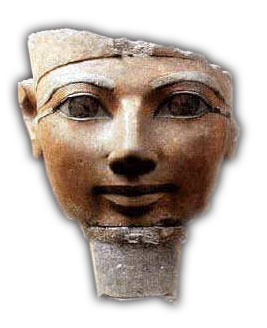
Hatshepsut is one of the most well known female rulers of Egypt.  Ruler in the 18th dynasty, Hatshepsut, meaning Foremost of Noble Women, became pharaoh when her two brothers died leaving her as her father's heir.  To have a female pharaoh was unprecedented, and probably most definitely unheard of as well.   Hatshepsut managed to rule Egypt for about twenty years, just before disappearing from history which coincided with "her" son Thuthmose III becoming pharaoh in his own right.

Family

Hatshepsut was the daughter of pharaoh Tuthmose I and his chief wife Aahmes.  She was the favorite of their three children.  When Tuthmose I died, his son Tuthmose II ascended the throne, but for the few years of his reign, Hatshepsut seems to have held the reins.  Upon his death, Hatshepsut, his half sister and wife, had produced only a daughter, Neferura, and Tuthmose II had sired a son through the commoner Isis.  

Impacts

Upon Tuthmose II's death his son, Tuthmose III, was in line for the throne, but due to his young age Hatshepsut was allowed to reign as queen dowager.  The pair "ruled" together for years until Hatshepsut finally proclaimed herself Pharaoh (it is assumed that she did this when Thuthmose III was reaching manhood).  This was unheard of, even with the higher status of women in Egypt compared to women in other cultures at the time.  However, before Hatshepsut, there were queens who had ruled Egypt, but none were a female Pharaoh.

Hatshepsut had many obstacles to overcome. The threat of revolt was always present, especially as her bitter nephew came of age.  She had to use propaganda and keen political skills.  Hatshepsut dressed in the traditional garb of male rulers: the shendyt kilt, the nemes headdress with its uraeus and khat head cloth, and the false beard.  Hatshepsut fought no wars during her reign.  Instead, she ordered expeditions to the land of Punt (present-day Somalia) in search of the ivory, animals, spices, gold and aromatic trees that Egyptians coveted. Hatshepsut emphasized not only her relationship to Tuthmose I her father, but her favor as having, as she claimed, to have been handpicked by her father above her two brothers.  Her last effort to be recognized as a legitimate Pharaoh, Hatshepsut constructed a fabulous temple in the Valley of the Kings by a tall plateau at Deir-el-Bahri, across the Nile from Thebes.  To keep control of the Egyptian empire for nearly 20 years Hatshepsut indeed was a master politician and an elegant stateswoman with total charisma.  

As Tuthmose III grew Hatshepsut's sovereignty grew tenuous.  Whether Tuthmose III killed Hatshepsut and Senmut (Hatshepsut's consort) is questionable but likely. Since he paid little respect to her in death, it is quite possible he paid even less in life.  But no matter how she died, we do know that she just disappear from history.

Death

The death of Hatshepsut remains a mystery.  Hatshepsut died, either as she was approaching or just entering middle age, and no record of her cause of death has survived.  It is believed that the hatred for his stepmother pushed Tuthmose III to erase her memory, existence, and any depictions of Hatshepsut by destroying any monuments erected during her reign.  While her temple still stands, her tomb nor her mummy have been found.   One of Hatshepsut's canopic jars was found, the one containing her liver. 

The recent identification of mummy in KV60 shows through CT scans indicate that the mummy died of metastatic bone cancer in the 50s.  In March 2006, Dr. Zahi Hawass claimed that this mummy was Hatshepsut, which was mislaid on the third floor of the Cairo Museum.  But in 2007 it was announced that Egyptologists believe they have identified Hatshepsut's mummy in the Valley of the Kings.  The decisive evidence was a molar in a wooden box inscribed with Hatshepsut's name.  It was found in 1881 in a cache of royal mummies hidden away for safekeeping in a near-by temple.

27 May 2009

Ramses II/Ramses the Great

Ramses II or Ramses the Great is the third pharaoh of the 19th dynasty. Often regarded as Egypt's greatest and most powerful pharaoh. He was one of Egypt's greatest warriors and peacemakers and made Egypt come to the height of her power. He created the model Egypt that anyone before or after could not replicate. According to some Egyptoligists and scholars Ramses II is believed to have been the Pharaoh of the Exodus. Ramses II was the first king in history to sign a peace treaty with his enemies, the Hittites, ending long years of wars and hostility.

Family

Ramses II was born to the principal wife Queen Tuy of the pharaoh Seti I. At 14 Ramses became Prince Regent by his father Seti I. In his early 20s became pharaoh and ruled Egypt for a total of 67 years by most records. This allowed him to be the second longest-ruling Pharaoh. Although Ramses II had a harem of wives, his favorite wife was Nefertari and it was presumed that he had over one hundred children with all his wives. Ramses II celebrated an unprecedented 14 sed festivals during his reign which was more than any other pharaoh. (The photo on the right is of a statue of Ramses II at Luxor)

Impacts

Ramses the Great built on a scale never before seen throughout Egypt and Nubia. He covered the land from the Delta into Nubia with buildings that no pharaoh had before done. He also founded the capital city of Pi- Ramses in the Delta which had previously served as a summer palace under Seti I. Ramses II built his magnificent moratorium temple the Ramesseum. His building was done on a scale unlike anything before. In Thebes, the ancient temples were transformed with each one of them reflecting honor to Ramses II as a symbol of this divine nature and power. When immortalizing himself into stone Ramses the Great insisted that his carvings were deeply engraved in the stone. This made them not only less susceptible to later alteration but also made them more prominent in the Egyptian sun, reflecting his relationship with the sun god, Ra. Among his other massive monuments is the complex of Abu Simbel which was carved out of sandstone facing east and the expansion of Luxor and Karnak. (The photo on the left is a picture of Abu Simbel)

Ramses II was a prolific ruler that fought to reclaim territory in Nubia and Western Asia. The Hittites and Asia Minor were his main opponents. As Pharaoh, he led a campaign known as the Battle of Kadesh where he tried to keep the newly acquired territory (modern day Syria) but lost the battle to the Hittites. Now seen as a standstill, Ramses II pulled back and Kadesh fell back into the hands of the Hittites. Later however, a treaty was signed, the territory divided, and Ramses II agreed to marry the daughter of the Hittite King. During his reign as Pharaoh, Ramses the Great attacked many of his enemies such as the Libyans, Nubians, and Syria.

Death

While his actual age upon is his in uncertain we do know he was in his 90s. He was buried in a tomb in the Valley of the Kings and his body later moved to a royal cache where it was discovered in 1881. Ramses II's mummy is now on display in the Cairo Museum. His tomb was KV7 in the Valley of the Kings and now remains empty. After years or being looted and weathered, it remains destroyed. Great amounts of effort are in progress with the hope of returning the tomb to a somewhat presentable stage. His mummy was eventually sent to Paris and diagnosed and treated for a fungal infection. During the numerous tests and examinations, battle wounds, old fractures, arthritis, and poor circulation were all revealed. For the last decades of his life, Ramses the Great was essentially crippled with arthritis and walked with a hunched back. A significant hole in the Pharaoh's mandible was detected while "an abscess by his teeth was serious enough to have caused death by infection, although this cannot be determined with certainty." Tests of the roots of Ramses II's hair proved that the original color of the king's hair was once red. In ancient Egypt, people with red hair were associated with the god Seth, the slayer of Osiris.

10 May 2009

First Intermediate Period

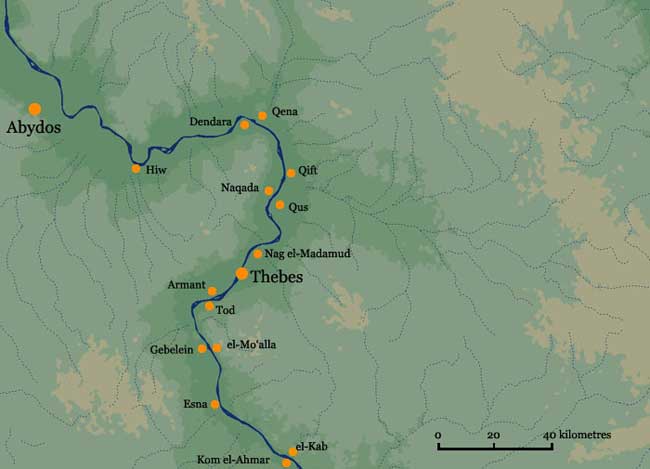
The First Intermediate Period, often referred to as the Dark Period in Egyptian history included the 7th-11th dynasties. There is very little monumental evidence that survives from this period as it was a time in history where rule of Egypt was roughly divided between two competing power bases. The first base was at Heracleopolis in Lower Egypt and the other base was at Thebes in Upper Egypt. Being the Dark Period instead of progressing forward as a civilization Egypt slipped backwards. Temples were pillaged and violated, their existing artwork was vandalized, and the statues of kings were broken or destroyed as a result of political chaos. During the 11th dynasty Upper and Lower Egypt were reunited under a Theban king.

While some of the causes of the downfall of the Old Kingdom are merely hypothetical, one reason that is often used is the extremely long reign of Pepi II. Pepi II was the last major pharaoh of the 6th Dynasty who ruled until he was 94 years old. Pepi II outlived many of his heirs and therefore created problems with succession in the royal household. Amidst the disorganization the Old Kingdom disintegrated. Provincial nomarchs also arose as a problem as their power grew. Towards the end of the Old Kingdom the positions of the nomarchs had became hereditary. As these nomarchs grew increasingly powerful and influential they became more independent from the king. As they raised their own armies intense rivalries and warfare arose between regions. With a dryer climate due to the Nile's recent low flood plain dissolution of centralized kingship increased.

For more First Intermediate Period intense information go here.

7th Dynasty Rulers

c. 2181-? BC

Netrikare

Menkare

Neferkare II

Neferkare III

Djedkare II

Neferkare IV

Merenhor

Menkamin I

Nikare

Neferkare V

Neferkahor

8th Dynasty Rulers

c. ?-2125 BC

Neferkare VI

Neferkamin II

Ibi I

Neferkaure

Neferkauhor

Neferirkare II

9th & 10th Dynasty Rulers

Herakleoplitan Rulers:

c. 2160-2025 BC

Khety Meryibre

Khety Wahkare

Merykare

Ity

11th Dynasty Rulers

Ruled At Thebes:

c. 2125-2025 BC

Mentuhotep I

Inyotef I (Sehertawy)

Inyotef II (Wahankh)

Inyotef III (Nakhtnebtepnefer)

Ruled A United Egypt:

c. 2055-1985 BC

Mentuhotep II

Mentuhotep III (Sankhkare)

Mentuhotep IV (Nebtawyre)