
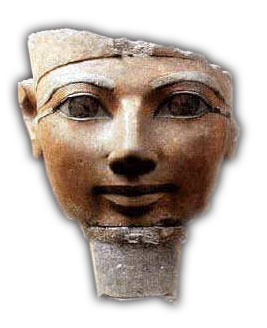
 Hatshepsut is one of the most well known female rulers of Egypt. Ruler in the 18th dynasty, Hatshepsut, meaning Foremost of Noble Women, became pharaoh when her two brothers died leaving her as her father's heir. To have a female pharaoh was unprecedented, and probably most definitely unheard of as well. Hatshepsut managed to rule Egypt for about twenty years, just before disappearing from history which coincided with "her" son Thuthmose III becoming pharaoh in his own right.
Family
Hatshepsut was the daughter of pharaoh Tuthmose I and his chief wife Aahmes. She was the favorite of their three children. When Tuthmose I died, his son Tuthmose II ascended the throne, but for the few years of his reign, Hatshepsut seems to have held the reins. Upon his death, Hatshepsut, his half sister and wife, had produced only a daughter, Neferura, and Tuthmose II had sired a son through the commoner Isis.

Impacts
Upon Tuthmose II's death his son, Tuthmose III, was in line for the throne, but due to his young age Hatshepsut was allowed to reign as queen dowager. The pair "ruled" together for years until Hatshepsut finally proclaimed herself Pharaoh (it is assumed that she did this when Thuthmose III was reaching manhood). This was unheard of, even with the higher status of women in Egypt compared to women in other cultures at the time. However, before Hatshepsut, there were queens who had ruled Egypt, but none were a female Pharaoh.
Hatshepsut had many obstacles to overcome. The threat of revolt was always present, especially as her bitter nephew came of age. She had to use propaganda and keen political skills. Hatshepsut dressed in the traditional garb of male rulers: the shendyt kilt, the nemes headdress with its uraeus and khat head cloth, and the false beard. Hatshepsut fought no wars during her reign. Instead, she ordered expeditions to the land of Punt (present-day Somalia) in search of the ivory, animals, spices, gold and aromatic trees that Egyptians coveted. Hatshepsut emphasized not only her relationship to Tuthmose I her father, but her favor as having, as she claimed, to have been handpicked by her father above her two brothers. Her last effort to be recognized as a legitimate Pharaoh, Hatshepsut constructed a fabulous temple in the Valley of the Kings by a tall plateau at Deir-el-Bahri, across the Nile from Thebes. To keep control of the Egyptian empire for nearly 20 years Hatshepsut indeed was a master politician and an elegant stateswoman with total charisma.
As Tuthmose III grew Hatshepsut's sovereignty grew tenuous. Whether Tuthmose III killed Hatshepsut and Senmut (Hatshepsut's consort) is questionable but likely. Since he paid little respect to her in death, it is quite possible he paid even less in life. But no matter how she died, we do know that she just disappear from history.

Death
The death of Hatshepsut remains a mystery. Hatshepsut died, either as she was approaching or just entering middle age, and no record of her cause of death has survived. It is believed that the hatred for his stepmother pushed Tuthmose III to erase her memory, existence, and any depictions of Hatshepsut by destroying any monuments erected during her reign. While her temple still stands, her tomb nor her mummy have been found. One of Hatshepsut's canopic jars was found, the one containing her liver.
The recent identification of mummy in KV60 shows through CT scans indicate that the mummy died of metastatic bone cancer in the 50s. In March 2006, Dr. Zahi Hawass claimed that this mummy was Hatshepsut, which was mislaid on the third floor of the Cairo Museum. But in 2007 it was announced that Egyptologists believe they have identified Hatshepsut's mummy in the Valley of the Kings. The decisive evidence was a molar in a wooden box inscribed with Hatshepsut's name. It was found in 1881 in a cache of royal mummies hidden away for safekeeping in a near-by temple.


Thanks for the information. Doing a report on Hatshepsut. I think she is an amzing women and role-model.
ReplyDeleteme Too. Thanks for the information. Doing a report on Hatshepsut. I think she is an amzing women and role-model.
ReplyDelete