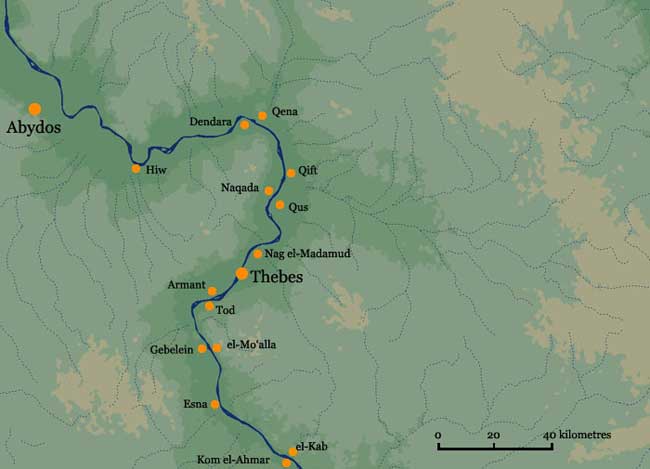
The Middle Kingdom Period typically includes the last half of the 11th dynasty through the 14th dynasty. The Middle Kingdom Period marked the beginning of the end when the once proud land of Egypt splintered into dozens of independent states was reunited by two kings, Intef and Mentuhotep. Together they re-established order and re-instituted the institution of the Egyptian king. However the Pharaohs of this period were not as powerful as before. Instead they showed themselves as taking care of their people, instead of being as god-kings like in the Old Kingdom. They had become the shepherds of the people while the the nomarchs were the new power. Under the pharaohs of the Middle Kingdom trade with foreign countries began again, irrigation projects were repaired, and the writing of texts started up from scratch. While the power of the pharaoh never really returned local cities and villages stayed independent under their local governors. With this change became a major threat to the monarchy. It seems that Amenemhet I was murdered by a conspiracy among local governors. The situation stayed perilous until Sesostris III finally broke the local governors and return the monarchy to its previous power.
Architecture started again including the building of fortresses. Amenemhet I built the series of fortresses that are known as the Wall of the Princes and Senusret I built a series of 13 fortresses from the Second Cataract up along the west coast of the Nile to protect against invaders.
The Middle Kingdom was, in general, a peaceful time. During Senusret III expeditions were sent to push the borders of Egypt outward. This was mostly the extent of military campaigns during the Middle Kingdom. However, Senusret III also regained the power once held by Mentuhotep I by instituting several internal reforms.
During the 13th dynasty
11th Dynasty Rulers
Ruled At Thebes:
c. 2125-2025 BC
Mentuhotep I
Inyotef I (Sehertawy)
Inyotef II (Wahankh)
Inyotef III (Nakhtnebtepnefer)
Ruled A United Egypt:
c. 2055-1985 BC
Mentuhotep II
Mentuhotep III (Sankhkare)
12th Dynasty Rulers
Amenemhat (Sehetepibre) | 1985-1955 BC
Senusret (Kheperkare) | 1965-1920 BC (1955-1965 BC joint rule with father)
Amenemhat II (Nubkaure) | 1922-1878 BC
Senusret III (Khakaure) | 1874-1855 BC
Amenemhat III ( Nimaatre) | 1855-1808 BC
Queen Sobekneferu ( Sobekkare) | 1799-1795 BC
13th Dynasty Rulers
parallel with the 14th dynasty & rulers/dates vary according to experts
c. 1795-1650 BC
Wegaf Khutawyre
Ameny Intef IV (Amenemhet V/Sankhibre)
Hor Auibre
Sobekhotep II (Amenmehet VI/Sekhemre Khutawy)
Khendjer Userkare
Sobekhotep III (Sekhemre Sewadjtawy)
Neferhotep I (Khasekhemre)
Sobekhotep IV (Khaneferre)
Merneferre Ay
Merhotepre Ini
Sankhenre Sewadjtu
14th Dynasty Rulers
parallel with the 13th dynasty & rulers/dates vary according to experts
c. 1795-1650 BC
Nehesy Aasehre
Yakobaam