
 This short video featuring Dr. Zahi Hawass arguing that artifacts need to be returned to Egypt. Because this artifacts deal with Egyptian history and culture he feels that they have been stolen and does not understand why countries will not graciously return them.
04 December 2009
Treasure Wars: Egypt's Curse
This short video featuring Dr. Zahi Hawass arguing that artifacts need to be returned to Egypt. Because this artifacts deal with Egyptian history and culture he feels that they have been stolen and does not understand why countries will not graciously return them.

Egyptian Seagoing Vessels Artifacts Discovered
 While this may have been five years ago, it is still amazing to re-read about the discoveries of ancient Egypt. This remarkable woman, Kathryn Bard, made the discovery of caves in the Wadi Gawasis. There, after such hard work, she was rewarded with one of the greatest treasures for an archaeologist:
Five years ago, Kathryn Bard made a remarkable discovery in the Egyptian desert. While digging with an archaeological team along the Red Sea coast, she reached into the opening of a wall — and felt nothing. Further excavation revealed an ancient man-made cave containing a mud brick, a small grinding stone, shell beads, and part of a box.
Days later, the team, led by Bard, a College of Arts & Sciences associate professor of archaeology, and Italian colleague Rodolfo Fattovich, uncovered the entrance to a second cave. Inside they found a network of larger rooms filled with dozens of nautical artifacts: limestone anchors, 80 coils of knotted rope, pottery fragments, ship timbers, and two curved cedar planks that likely are steering oars from a 70-foot-long ship. According to hieroglyphic inscriptions, the ship was dispatched to the southern Red Sea port of Punt by Queen Hatshepsut during the 15th century B.C.
“It just gave me chills to stumble across such a frozen moment in time,” Bard recalls. “The ropes were perfectly preserved. They looked as if they’d been coiled yesterday.”
The team discovered seven caves at Wadi Gawasis containing relics dating back 4,000 years. The first pieces ever recovered from Egyptian seagoing vessels, they offer a tantalizing glimpse into an elaborate network of Red Sea trade.
Best known for its exports of gold, incense, ebony, elephant ivory, and exotic animals, the exact location of the port city Punt remains a mystery; Bard believes it was in present-day eastern Sudan. Inscriptions discovered more than a century ago indicate that Egyptian pharaohs mounted naval expeditions to Punt as far back as the Old Kingdom (2686 –2125 B.C.), and Bard’s findings give credibility to the legend in the form of stelae, limestone slabs installed in niches outside of the second cave.
Most of the stelae are indecipherable, worn blank from centuries of wind and sand. But one was in near-perfect condition. “I found it lying facedown in the desert,” Bard says, “and it contained the complete historical text of two expeditions, one to Punt and one to Bia-Punt, as ordered by King Amenemhat III, who ruled at about 1800 B.C.”
In addition to the stelae, the team recovered more than 40 cargo boxes, 2 bearing painted inscriptions reading “The wonders of Punt.”
“It was like a modern-day packaging label,” Bard says. “The preservation was incredible.”
Since the initial discovery, the team has returned to Wadi Gawasis each year and uncovered more artifacts: clay sealings, boxes and bags, cooking tools, fragments of a letter written on a sheet of papyrus. “We even found a piece of pottery that describes how to prepare a meal for 100 men,” she says. “The Egyptians kept records of everything.”
Bard will make her fifth voyage to Egypt in late December. “We think there’s another cave,” she says. “And through analysis of satellite images, we think we’ve found some sort of walled structure beneath the harbor that may be a ship slipway or a dock.”
The team limits its excavations to six weeks between fall and spring semesters to avoid summer heat and humidity — not to mention the desert’s sizable population of poisonous vipers, which hibernate during the winter.
It all sounds very Raiders of the Last Ark, but don’t compare Bard to Indiana Jones. “He bungles into anything, anywhere,” she says. “There’s no planning, no organization, just lots of adventure. Real archaeology is nothing like the movies.”
Bard has never outrun a Nazi, but she has had a narrow escape, and it led her to Wadi Gawasis. In 1998, she and an excavation team fled war-torn Ethiopia via a mountainous one-lane dirt road as bombs erupted in the distance. The experience, though harrowing, brought her to Egypt.
“We knew we couldn’t go back to Ethiopia,” Bard says, “so we decided to explore the other end of the Red Sea. Little did we know what we’d find.”
See the videos here!
{via BU.edu}
03 December 2009
Tuthmosis II
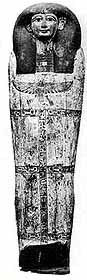 Tuthmosis II was pharaoh during the 18th Dynasty. While the length of his reign is constantly in dispute, he was the immediate successor of his father Thutmose I. Tuthmosis II's rule was relatively short and is estimated to be 1512 B.C.E. - 1503 B.C.E. (Oxford History states 1492 B.C.E. - 1479 B.C.E. while the Chronicle of the Paraohs 1518 B.C.E. - 1504 B.C.E.). Had his two older brothers, Wadjmose and Amenmose, not died, Tuthmosis II would not have become pharaoh. the eldest sons of Tuthmosis I, leaving him as the only heir. The eldest son of Mutnefert, a minor royal queen, Tuthmosis II died in his early thirties. His throne name was A-kheper-en-re, which means "Great is the Form of Re."
Family

Tuthmosis II was married to Hatshepsut, his half-sister. Marrying within the family was not uncommon among the royal families as royal blood was thought to run through the women. Because of the frequency of the intermarrying Tuthmosis II himself was both physically and mentally weak.
Tuthmosis II had one son by a minor wife, Iset, who would be his heir, Tuthmosis III. Tuthmosis would not see the throne until his step-mother's death. Tuthmosis II had two daughters by Hatshepsut, but she bore him no sons. Tuthmosis II say his wife's ambitions and attempted to secure his son's reign, but Tuthmosis III was still too young when Tuthmosis II died. Hatshepsut took the advantage and named herself as regent, and then taking on the full regalia of the pharaoh.
ImpactsTuthmosis II had one son by a minor wife, Iset, who would be his heir, Tuthmosis III. Tuthmosis would not see the throne until his step-mother's death. Tuthmosis II had two daughters by Hatshepsut, but she bore him no sons. Tuthmosis II say his wife's ambitions and attempted to secure his son's reign, but Tuthmosis III was still too young when Tuthmosis II died. Hatshepsut took the advantage and named herself as regent, and then taking on the full regalia of the pharaoh.

Tuthmosis II was able preserved his father's, Tuthmosis I, empire with two campaigns. In the first year of his reign Tuthmosis II crushed a revolt in Nubia and later he led a campaign against the Shosu Bedouin of southern Palestine who were also threatening the peace. Testiments of his campaigns are inscripted in the temple at Deir el-Bahari and a rock-cut stele at Sehel south of Aswan.
Tuthmosis II's building projects included traces of a temple just north of the temple of Medinet Habu on the West Bank at Luxor (aka, Thebes). This temple is known as Shespet-ankh, Chapel of Life, and was finished by Tuthmosis III. Tuthmosis II also built a pylon shaped limestone gateway in front of the Fourth Pylons forecourt at Karnak (which also had to be completed by Tuthmosis III). Scenes on the gate depict Tuthmosis II with Hatshepsut, sometimes Hatshepsut alone, Tuthmosis II is shown receiving crowns, and his daughter, Nefrure and wife, Hatshepsut receiving life from the gods.
DeathTuthmosis II's building projects included traces of a temple just north of the temple of Medinet Habu on the West Bank at Luxor (aka, Thebes). This temple is known as Shespet-ankh, Chapel of Life, and was finished by Tuthmosis III. Tuthmosis II also built a pylon shaped limestone gateway in front of the Fourth Pylons forecourt at Karnak (which also had to be completed by Tuthmosis III). Scenes on the gate depict Tuthmosis II with Hatshepsut, sometimes Hatshepsut alone, Tuthmosis II is shown receiving crowns, and his daughter, Nefrure and wife, Hatshepsut receiving life from the gods.
 Upon his early death, Tuthmosis II's son Tuthmosis III was too young to rule and Hatshepsut took over as regent. Tuthmosis II's mummy was found in a royal cache of mummies at Deir el-Bahari above Hatshepsut's Mortuary Temple in 1881 along with 39 other mummies. He had been interred along with other 18th and 19th dynasty leaders including Ahmose I, Amenhotep I, Tuthmosis I, Tuthmosis III, Ramses I, Seti I, Ramses II, and Ramses IX, as well as the 21st dynasty pharaohs Psusennes I, Psusennes II, and Siamun. His mummy can now be seen at the Egyptian Museum in Cairo. His original tomb which should have been in the Valley of the Kings has yet to be found. Tuthmosis II's mummy was unwrapped by Gaston Maspero on July 1, 1886, who said that "He [Tuthmosis II] had scarcely reached the age of thirty when he fell a victim to a disease of which the process of embalming could not remove the traces. The skin is scabrous in patches, and covered with scars, while the upper part of the skull is bald; the body is thin and somewhat shrunken, and appears to have lacked vigour and muscular power."
Subscribe to:
Posts (Atom)
