
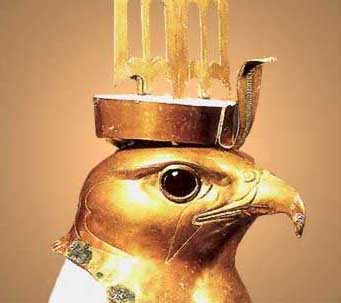
 Horus quickly rose throughout Egypt as a supreme god - eventually merging his identity with Ra. He was acknowledged as Prince of the Gods. He is known by numerous names, including: Heru, Hor, Harendotes/Har-nedj-itef (Horus the Avenger), and Har-Pa-Neb-Taui (Horus Lord of the Two Lands). To the Egyptians, Horus was seen as the patron of the living Pharaoh, rulers, war, young men, light, the sun, and various others. Horus was worshiped throughout all of Egypt in his numerous forms.
Horus has no true form just as all Egyptian deities, however, he is most commonly remembered as the falcon headed god. He was seen as a hawk or falcon, a falcon headed lion, a bull, the double crown, the winged disk, the Udjat, a sphinx, iron, and a blacksmith. He was also symbolized behind the Pharaoh sitting on his neck as a falcon spreading its wings to either side of the Pharaoh's head supposedly whispering guidance in his ear.
The Egyptian Pharaoh was supposed to be the earthly embodiment of Horus. At the same time, the Pharaohs were the followers of Ra and so Horus picked up the association with the sun as well. To the Egyptian people this solar deity became identified as the son of Osiris. As with all the Egyptian deities, conflicts arose from newly created deities, modified deities, and combined deities, and so numerous distinct forms arose for Horus just like the others. They can be divided into two groups, solar and Osirian, based on the parentage of the particular form of Horus. If he is said to be the son of Isis, he is Osirian - otherwise he is a solar deity. The solar Horus was called the son of Atum, or Re, or Geb and Nut.
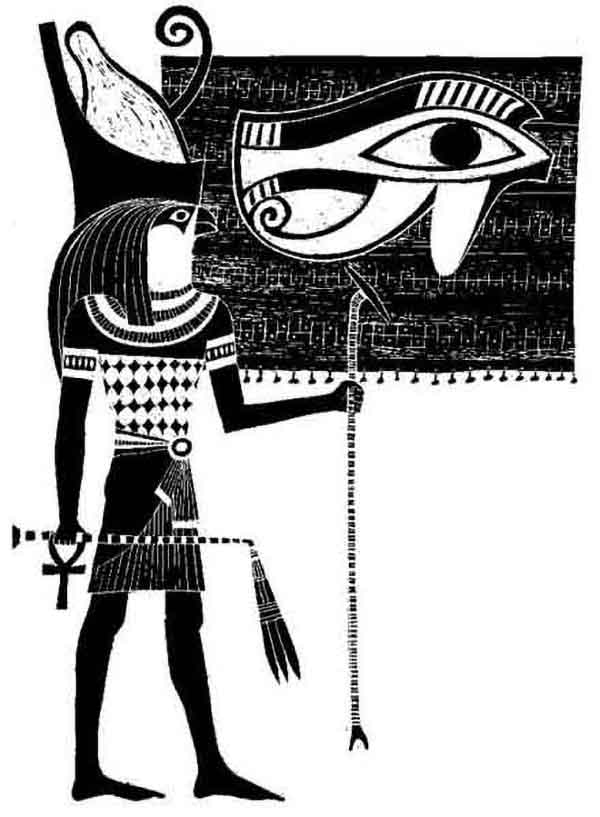 The most famous story involving Horus is the Legend of Osiris and Isis. In this legend Horus is the child of Osiris, begot when his father Osiris was brought back to life by his mother, Isis. He grows to manhood and avenges the death of his father by attacking his Uncle Set. The two are said to battle daily to ensure the safety of the world where Horus ensures the safety of the world.
Since Horus was said to be the sky, he rapidly became considered to also contain the sun and moon. It was said by the Egyptians that the sun was one of his eyes and the moon the other, and that they traversed the sky when as a falcon, Horus flew across the sky. According to legend the reason that the moon was not as bright as the sun was explained by a tale, known as the Contesting of Horus and Set. It was said that Set, the patron of Lower Egypt, and Horus, the patron of Upper Egypt, had battled for Egypt brutally, with neither side victorious, until eventually the gods sided with Horus. During the struggle, Set had lost a testicle, explaining why the desert, which Set represented, is infertile. Horus' right eye was gouged out, which explained why the moon was so weak compared to the sun. It was also said that during a new-moon, Horus became blinded and while blind, was considered dangerous as Horus sometimes attacked his friends after mistaking them for enemies.
A few of Horus' persona's include:
Harmakhet-Horus was god of the dawn and of the morning sun. Harmakhet's form is that of a sphinx or a sphinx with the head of a ram. It is thought that the Great Sphinx, staring at the eastern horizon, represents him.
Harsiesis-Horus was the son of Osiris and Isis. He was conceived magically after the death of Osiris, and Isis hid him away on an island to protect him from Set. In this form he is worshipped as an infant.
Horus the Elder (Haroeris)-Horus was a god of light, his left eye was the sun and his right eye the moon. He was the brother of Osiris and Set, and the husband of Hathor.
Ra Harakhte-A combined god of Horus and Ra, he was the god of the sun and took it on its daily path across the sky. He is represented as a falcon or a falcon-headed man wearing the solar disk and the double crown.


No comments:
Post a Comment