Showing posts with label god. Show all posts

19 January 2010

Horus

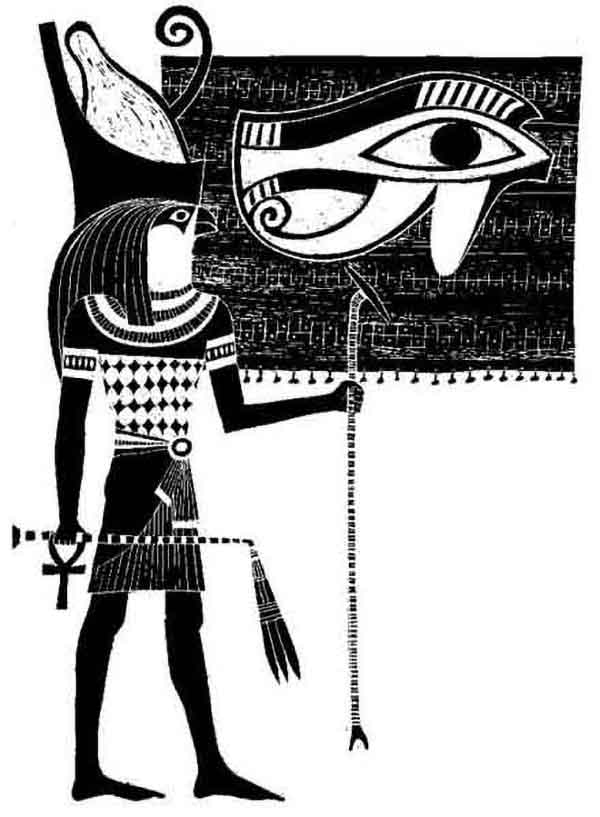
HorusHorus quickly rose throughout Egypt as a supreme god - eventually merging his identity with Ra. He was acknowledged as Prince of the Gods. He is known by numerous names, including: Heru, Hor, Harendotes/Har-nedj-itef (Horus the Avenger), and Har-Pa-Neb-Taui (Horus Lord of the Two Lands). To the Egyptians, Horus was seen as the patron of the living Pharaoh, rulers, war, young men, light, the sun, and various others. Horus was worshiped throughout all of Egypt in his numerous forms.

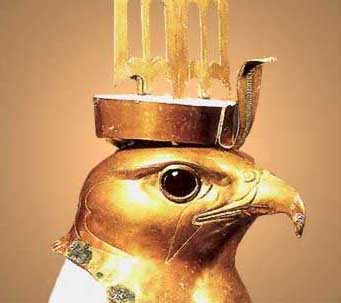
Horus has no true form just as all Egyptian deities, however, he is most commonly remembered as the falcon headed god. He was seen as a hawk or falcon, a falcon headed lion, a bull, the double crown, the winged disk, the Udjat, a sphinx, iron, and a blacksmith. He was also symbolized behind the Pharaoh sitting on his neck as a falcon spreading its wings to either side of the Pharaoh's head supposedly whispering guidance in his ear.

The Egyptian Pharaoh was supposed to be the earthly embodiment of Horus. At the same time, the Pharaohs were the followers of Ra and so Horus picked up the association with the sun as well. To the Egyptian people this solar deity became identified as the son of Osiris. As with all the Egyptian deities, conflicts arose from newly created deities, modified deities, and combined deities, and so numerous distinct forms arose for Horus just like the others. They can be divided into two groups, solar and Osirian, based on the parentage of the particular form of Horus. If he is said to be the son of Isis, he is Osirian - otherwise he is a solar deity. The solar Horus was called the son of Atum, or Re, or Geb and Nut.

HorusThe most famous story involving Horus is the Legend of Osiris and Isis. In this legend Horus is the child of Osiris, begot when his father Osiris was brought back to life by his mother, Isis. He grows to manhood and avenges the death of his father by attacking his Uncle Set. The two are said to battle daily to ensure the safety of the world where Horus ensures the safety of the world.

Since Horus was said to be the sky, he rapidly became considered to also contain the sun and moon. It was said by the Egyptians that the sun was one of his eyes and the moon the other, and that they traversed the sky when as a falcon, Horus flew across the sky. According to legend the reason that the moon was not as bright as the sun was explained by a tale, known as the Contesting of Horus and Set. It was said that Set, the patron of Lower Egypt, and Horus, the patron of Upper Egypt, had battled for Egypt brutally, with neither side victorious, until eventually the gods sided with Horus. During the struggle, Set had lost a testicle, explaining why the desert, which Set represented, is infertile. Horus' right eye was gouged out, which explained why the moon was so weak compared to the sun. It was also said that during a new-moon, Horus became blinded and while blind, was considered dangerous as Horus sometimes attacked his friends after mistaking them for enemies.

A few of Horus' persona's include:
Harmakhet-Horus was god of the dawn and of the morning sun. Harmakhet's form is that of a sphinx or a sphinx with the head of a ram. It is thought that the Great Sphinx, staring at the eastern horizon, represents him.

Harsiesis-Horus was the son of Osiris and Isis. He was conceived magically after the death of Osiris, and Isis hid him away on an island to protect him from Set. In this form he is worshipped as an infant.

Horus the Elder (Haroeris)-Horus was a god of light, his left eye was the sun and his right eye the moon. He was the brother of Osiris and Set, and the husband of Hathor.

Ra Harakhte-A combined god of Horus and Ra, he was the god of the sun and took it on its daily path across the sky. He is represented as a falcon or a falcon-headed man wearing the solar disk and the double crown.

15 November 2009

Isis

IsisIsis is the ancient Egyptians' goddess of fertility and motherhood. Isis literally means: female of throne (i.e. Queen of the throne). Her original headdress was an empty throne chair belonging to Osiris, her murdered husband. As Isis was the personification of the throne, she was an important source of the Pharaoh's power.

Noted in the Book of the Dead, Isis is said to be she who gives birth to heaven and earth, knows the orphan, knows the widow, seeks justice for the poor, and shelter for the weak. Amoung Isis' seemingly endless titles are: Queen of Heaven, Mother of the Gods, The One Who is All, Lady of Green Crops, The Brilliant One in the Sky, Great Lady of Magic, Mistress of the House of Life, She Who Knows How To Make Right Use of the Heart, Light-Giver of Heaven, Lady of the Words of Power, and Moon Shining Over the Sea.

In the heaven's Isis is the star Sept (Sirius). Sept marks the beginning of a new year and announces the Inundation of the Nile. Isis held numerous positions with numerous names. A few include being light-giver at this season of the year called Khut, the mighty earth-goddess Usert, the Great Goddess of the Underworld Thenenet, the power which shot forth the Nile flood Sati and Sept, the embracer of the land and producer of fertility by her waters Anqet, the producer and giver of life Ankhet, the goddess of cultivated lands and fields Sekhet, and the goddess of the harvest Renenet.

IsisIsis' husband, Osiris, was lord of the Underworld, and as such Isis was the great lady of the Underworld. In this capacity she assisted in transforming the bodies of the blessed dead into those wherein they were to live in the realm of Osiris. Readers often remember the duo of Isis and Osiris as it was Osiris that was killed by his brother Set. Isis resurrected him and became pregnant, but Set cut Osiris into numerous pieces scattering them throughout the land. Osiris then entered the Underworld and became the rightful ruler.

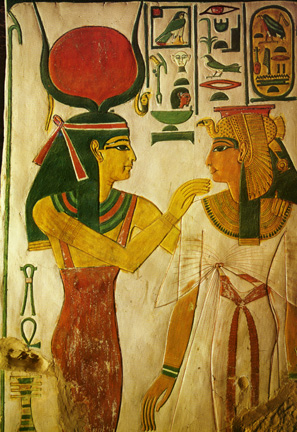
Isis is portrayed as a woman wearing a long sheath dress and crowned with the hieroglyphic sign for a seat, sometimes holding a lotus, and sometimes as a sycamore tree. After Isis assimilated Hathor, Isis' headdress was replaced with that of Hathor: the horns of a cow on her head, and the solar disc between them. Isis is generally depicted with her son, Horus, with a crown and a vulture, and sometimes as a kite bird flying above Osiris's body. She often holds the ankh.

12 November 2009

Hathor

HathorHathor (meaning, "The House of Horus") was known to the Ancient Egyptians as the goddess of the sky, the sun, music, dance and the arts. She was often symbolized as a cow bearing the sun disk between her horn and a woman in queenly raiment wearing the sun disk and horns on her head. Dating back to the predynastic time, Hathor is one of the, if not the, oldest goddess for the Egyptians. She was originally associated with the pharaoh as his queen. Hathor became the incarnation of dance and one of Inspiration. Worship of Hathor had her male and female priests dancing in rituals and people flocking to have their dreams explained.

Hathor was originally a personification of the Milky Way, which was considered to be the milk that flowed from the udders of a heavenly cow. It was throughout the ages that Hathor took on her other characteristics, some that overshadowded others, and other identities and forms. She is almost a confusing goddess. As an ancient goddess the Egyptians attempted to keep her throughout the periods but added or took away from her. Thus her marriages, children, names, and characteristics vary according to period. Here we'll just discuss the few the prevailed most often.

HathorHathor is also Mehturt (for about 3,000 years), meaning great flood. This aspect of Hathor had the Egyptians identifying her as responsible for the yearly inundation of the Nile. Being recognized as responsible for the flooding of the Nile also had Hathor seen as a herald of imminent birth (when the amniotic sac breaks it is an indicator that the child is due to be born). This eventually expanded to Hathor being a goddess of fertility.

For a short time Hathor was associated with Sekhmet (a war goddess) as Sekhmet-Hathor. Due to their similar physical associations they were combined to create the lioness goddess. One version claims this story: as the Eye of Ra - defender of the sun god - Hathor was sent out to punish the people (in the form of Sekhmet). She slaughtered people by the hundreds and Ra relented seeing the utter destruction and commanded her to stop. Sekhment refused as she was blood thirsty. To stop the slaughter, bear was colored red (to resemble blood) and poured over the killing fields. When Sekhmet drank the beer, she became drunk and drowsy, and slept for three days. When she awoke she had no taste for human flesh and mankind was saved. From then on she was renamed her Hathor. As a result, soldiers also prayed to Hathor/Sekhmet to give them her strength and focus in battle.

Hathor was the mother of Horus and wife of Ra. Although as Egyptian mythology continued she was said to be married to Thoth, as Ra and Atum were the same deity, making it complicated for her to be wife to her son whom she created. As wife of Ra, Hathor held the title Mistress of Heaven and the Eye of Ra. She is also later said to be Hathor's wife. In reality, she was probably meant to have just been combined with the original wives of the gods creating a stronger deity, not replacing the wives of old.

08 November 2009

Amun/Amen

Among the group of the most well known ancient Egyptians gods is Amun (also seen as Amen). He is the second largest god on record for the ancient Egyptians in his dual personality as Amun-Ra. Record of Amun is first seen in the early Pyramid Texts. Amun's attributes are sometimes in question, but are fairly understood to be the literal meaning of his name: The Essential and The Hidden. As a creator deity Amun was the champion of the poor and central to personal piety. Amun was self created and is not considered to be immanent within creation nor was creation seen as as an extension of himself. Amun's position as King of the Gods developed to the point of virtual monotheism were other gods became manifestations of him.

Amun is seen as the breath of life, a creative force, and co-creator of the Ba. However, Amun did not engender the world/creation. The pharaohs attributed all their successful enterprises to Amun and they lavished their wealth and captured spoil on the construction of temples dedicated to Amun. It is the worship of Amun that Akhenaten banned (among other gods) and attempted to destroy during his reign as he believed the priests and the worship to have become corrupt. The cult of Amun-Ra became so powerful that its priesthood grew very large and influential, so that at one point, priests of the deity did actually rule Egypt during the 21st Dynasty. Amun while suppose to be sexless but is seen as the male aspect of the persona while Amunet is the female aspect. His consort is seen at Mut.

Amun was most often combined with the god, Ra. Seen as the dual god, Amun-Ra, he was believed to represented one of ancient Egypt's most complex theologies. Amun-Ra became a hidden, secret god as the Egyptians called him "the hidden one" or "the secret one." This dual personality is also known as the Sun God, the main aspect of Ra. Amun-Ra's name and physical appearance were the unknown, thus his unknowable essence. While suppose to be seperate versions of the god, Amun and Amun-Ra have in many ways become interchangeable.

Hymns to Amun often read that he is "hidden to his children, "and "hidden to gods and men." In the later periods the name Amen appears to been connected with the root men - "to abide, to be permanent" - and one of the attributes applied to him was Eternal.

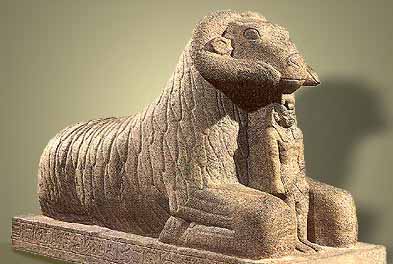
Amun is seen in five forms: 1) As a man, when he is seen seated on a throne, and holding in one hand the scepter, and in the other the symbol of "life." 2) As a man with the head of a frog, whilst his female counterpart Amunet has the head of a uraeus. 3) As a man with the head of a uraeus, whilst his female counterpart has the head of a cat. 4) As an ape. 5) As a lion couching upon a pedestal.

06 November 2009

Ra

Ra/ReRa (also spelled Re) dominates most of Egyptian religion as one of the primary deities throughout the span of the empire. Ra was the patron of the sun, heaven, Kingship of the pharaohs, power, and divine light. He is seen as one of the head gods as it is he who bestows power unto the pharaohs giving them the divine right to rule the Two Lands. Although not a contemporary view, E. A. Wallis Budge (1857-1934) claimed that Ra was the one god of Egyptian monotheism; from which all other deities were aspects, manifestations, phases, or forms.

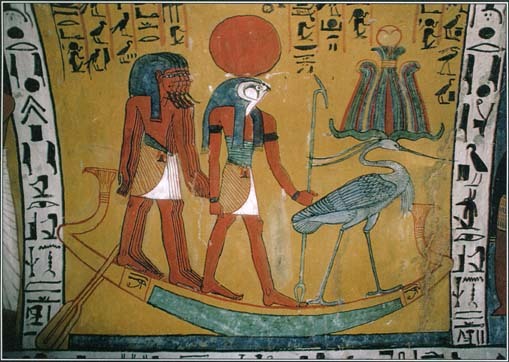
Ra's physical appearance changed throughout the periods of ancient Egypt, however he is most often seen as a falcon headed pharaoh wearing the sun disk on his head. However, the easiest way to identify Ra is by the Sun disk over an item, generally speaking. Ra was worshiped as king of the gods (hence giving him the right to bestow Kingship) and the father of all creation. As the sun god, he commanded the chariot that rode across the sky during the day, with noon being of heightened importance. Like Osiris, Ra is the only other Egyptian god who is not on the earth. As an aging god, Ra is still powerful, yet too old to deal with his children any longer. This has caused him to go exclusively into the sky and watch over the world while his great-grandson, Horus, rules over the earth and the gods in his stead.

Acknowledged as the father of all, Ra had 4 children. However, as mythology changed so did Ra's wife or significant other. Early on Hathor was said to be Ra's wife, however, that changed into Hathor being Ra's daughter, then that Ra originally created Hathor as Sekhment (the fierce warrior lioness) as the Avenging Eye of Ra but then changed her into Hathor when his anger subsided. It is agreed that the following 4 are Ra's children: Nut (sky), - Shu, Tefnut, and Geb (Earth). Expanding the family, Nut and Geb created 4 children: Set, Osiris, Isis, and Nephthys. Isis and Osiris then had their only child Horus, who took over Ra's watch over earth. (Some accounts have Shu and Tefnut as Ra's only children, they in turn had Nut and Geb)

Ra AmuletOver time Ra also became a composite deity with the Atum. Known as Ra-Atum or Atum-Ra they were a primordial creative force. In the form of Atum-Ra, Ra began to symbolized the setting sun and its journey through the underworld to its rising again in the east. He also is generally seen with the god Amun, creating Amun-Ra as the Hidden God/the Sun God.
----------------
Here is an Egyptian legend concerning Ra:

The Legend of Ra and Isis

Now Isis was a woman who possessed words of power; her heart was wearied with the millions of men, and she chose the millions of the gods, but she esteemed more highly the millions of the khu's. And she meditated in her heart, saying, "Cannot I by means of the sacred name of God make myself mistress of the earth and become a goddess like unto Ra in heaven and upon earth?"

Now, behold, each day Ra entered at the head of his holy mariners and established himself upon the throne of the two horizons. The holy one had grown old, he dribbled at the mouth, his spittle fell upon the earth, and his slobbering dropped upon the ground. And Isis kneaded it with earth in her hand, and formed thereof a sacred serpent in the form of a spear; she set it not upright before her face, but let it lie upon the ground in the path whereby the great god went forth, according to his heart's desire, into his double kingdom. Now the holy god arose, and the gods who followed him as though he were Pharaoh went with him; and he came forth according to his daily wont; and the sacred serpent bit him. The flame of life departed from him, and he who dwelt among the cedars was overcome. The holy god opened his mouth, and the cry of his majesty reached unto heaven. His company of gods said, "What hath happened?" and his gods exclaimed, "What is it?" But Ra could not answer, for his jaws trembled and all his members quaked; the poison spread swiftly through his flesh just as the Nile invadeth all his land.

When the great god had established his heart, he cried unto those who were in his train, saying, "Come unto me, O ye who have come into being from my body, ye gods who have come forth from me, make ye known unto Khepera that a dire calamity hath fallen upon me. My heart perceived it, but my eyes see it not; my hand hath not caused it, nor do I know who hath done this unto me. Never have I felt such pain, neither can sickness cause more woe than this. I am a prince, the son of a prince, a sacred essence which hath preceded from God. I am a great one, the son of a great one, and my father planned my name; I have multitudes of names and multitudes of forms, and my existence is in every god. I have been proclaimed by the heralds Tmu and Horus, and my father and my mother uttered my name; but it hath been hidden within me by him that begat me, who would not that the words of power of any seer should have dominion over me. I came forth to look upon that which I had made, I was passing through the world which I had created, when lo! something stung me, but what I know not. Is it fire? Is it water? My heart is on fire, my flesh quaketh, and trembling hath seized all my limbs. Let there be brought unto me the children of the gods with healing words and with lips that know, and with power which reacheth unto heaven." The children of every god came unto him in tears, Isis came with her healing words and with her mouth full of the breath of life, with her enchantments which destroy sickness, and with her words of power which make the dead to live. And she spake, saying, "What hath come to pass, O holy father? What hath happened? A serpent hath bitten thee, and a thing which thou hast created hath lifted up his head against thee. Verily it shall be cast forth by my healing words of power, and I will drive it away from before the sight of thy sunbeams."

The holy god opened his mouth and said, "I was passing along my path, and I was going through the two regions of my lands according to my heart's desire, to see that which I had created, when lo! I was bitten by a serpent which I saw not. Is it fire? Is it water? I am colder than water, I am hotter than fire. All my flesh sweateth, I quake, my eye hath no strength, I cannot see the sky, and the sweat rusheth to my face even as in the time of summer." Then said Isis unto Ra, "O tell me thy name, holy father, for whosoever shall be delivered by thy name shall live." [And Ra said], "I have made the heavens and the earth, I have ordered the mountains, I have created all that is above them, I have made the water, I have made to come into being the great and wide sea, I have made the 'Bull of his mother,' from whom spring the delights of love. I have made the heavens, I have stretched out the two horizons like a curtain, and I have placed the soul of the gods within them. I am he who, if he openeth his eyes, doth make the light, and, if he closeth them, darkness cometh into being. At his command the Nile riseth, and the gods know not his name. I have made the hours, I have created the days, I bring forward the festivals of the year, I create the Nile-flood. I make the fire of life, and I provide food in the houses. I am Khepera in the morning, I am Ra at noon, and I am Tmu at even." Meanwhile the poison was not taken away from his body, but it pierced deeper, and the great god could no longer walk.

Then said Isis unto Ra, "What thou hast said is not thy name. O tell it unto me, and the poison shall depart; for he shall live whose name shall be revealed." Now the poison burned like fire, and it was fiercer than the flame and the furnace, and the majesty of the god said, "I consent that Isis shall search into me, and that my name shall pass from me into her." Then the god hid himself from the gods, and his place in the boat of millions of years was empty. And when the time arrived for the heart of Ra to come forth, Isis spake unto her son Horus, saying, "The god hath bound himself by an oath to deliver up his two eyes" (i.e., the sun and moon). Thus was the name of the great god taken from him, and Isis, the lady of enchantments, said, "Depart, poison, go forth from Ra. O eye of Horus, go forth from the god, and shine outside his mouth. It is I who work, it is I who make to fall down upon the earth the vanquished poison; for the name of the great god hath been taken away from him. May Ra live! and may the poison die, may the poison die, and may Ra live!" These are the words of Isis, the great goddess, the queen of the gods, who knew Ra by his own name.

31 October 2009

Osiris

OsirisOne of the major Egyptian gods, Osiris was the god of the Afterlife, underworld, or the dead. He is one of the oldest gods on record, with his name appearing on Palermo Stone c. 2500 B.C. The mythology of Osiris comes from the allusions contained in the Pyramid Text and later texts including the New Kingdom documents such as the Shabaka Stone and some Greek writings.

Osiris is one of the most fascinating gods of Egyptian culture. He was not only a merciful judge of the dead in the afterlife, but also the ruler of an underworld agency that granted all life, including sprouting vegetation and the fertile flooding of the Nile River. He is described as the "Lord of love", "He Who is Permanently Benign and Youthful" and the "Lord of Silence." Upon death, the Kings of Egypt were associated with Osiris as when Osiris rose from the dead they would, in union with him, inherit eternal life. This distinction held by pharaohs only lasted until about the New Kingdom, when all people of Egypt came to be associated with Osiris at death if they could afford the costly assimilation rituals.

Osiris' family places him as the oldest son of the Earth god, Geb (also debated to be Ra or Re, also known as Amun Ra), and the sky goddess, Nut. He was conceived with the earth and sky met. He is the brother and husband of Isis and the brother of Set. Horus, is his posthumously begotten son. Osiris later in Egyptian history was associated with the name Khenti-Amentiu, (Foremost of the Westerners) a reference to his kingship in the land of the dead. He occasionally appears green or blue-green to represent his character as the god of Life in the cycle of rebirth.

Due to Osiris' story and his battle with his brother, Set, he became associated with the cycles observed in nature, in particular vegetation and the annual flooding of the Nile. Below is the story of Osiris. Not one account in existence is complete. This one is taken from Plutarch the Greek writer with the Greek names changed to make it easier reading and edited by Jim Loy. Enjoy!
--------
The Legend of Osiris

When Ra reigned as king of Egypt, Thoth (Djehuty) prophesied that Ra's wife Nut would have a son who would reign as king. Ra cursed Nut and said, "Nut will give birth to no son on any day of any year, nor at night time either." Ra's curse could not be broken, but Thoth had a clever plan. He went to the moon god Khonsu and offered to play him a game of Senet. Khonsu was a great gambler, and bet some of his own moonlight. Thoth defeated Khonsu over and over, until he had won five days from Khonsu. Thoth fit those five days between the end of the old year, and the beginning of the new year, the year having 360 days. And so here were five days that were not part of any year. Nut gave birth to five children on those five days, Osiris on the first day, Harmachis on the second day, Set on the third, Isis on the fourth, and Nephthys on the fifth.

When Osiris was born, a man of Thebes named Pamyles heard a voice telling him to spread the word that Osiris the good and great king, and savior of mankind, had been born. And so Pamyles spread the word, and Nut entrusted the baby Osiris to Pamyles, to raise and educate, with the help of Thoth. The five children grew up, and Osiris married Isis, and Set married Nephthys.

Eventually, Ra ascended into the heavens to sail across the sky every day, and Osiris sat on the throne, and ruled Egypt as a good and wise king, and Egypt flourished under his rule, and the people (who had previously lived like wild animals) became civilized (learning to use the inundation to replenish the land). And the people worshipped Osiris.

Osiris left Egypt, to teach the people of other lands, and Isis ruled in his place. Set plotted to steal Osiris' throne, but Isis prevented this. Set became the leader of 72 wicked men, along with Aso the evil queen of Ethiopia. He secretly learned the measurements of the body of Osiris, and had a beautiful wooden chest made that was exactly the right size to hold Osiris. Then he invited Osiris to a great feast. Everyone at the feast admired the wooden chest, and desired to own it. Set said that the chest would belong to whoever it fit best. Each person at the feast lay down in the chest, but it fit none of them. When Osiris lay down in the chest, Set and his conspirators, closed the lid, nailed it shut, poured molten lead over it to seal the cracks, and threw it into the Nile. And so Osiris died in the 28th year of his reign.

The chest floated into the Great Green, the sea north of Egypt, and came ashore at Byblos, in Syria. There it was flung by the waves into a tamarisk bush. The bush quickly grew into a mighty tree which enclosed the wooden chest. The king of Syria marveled at the tree, and had it cut down and made into a pillar which supported the roof of his palace.

Meanwhile, Set ruled as king of Egypt; it was a time of great trouble in Egypt. Isis was stricken with grief, and put on the apparel of mourning, and cut off a lock of her hair. Then she went in search of her husband's body, as he had to be buried so that Osiris could go to the Duat, the land of the dead. Eventually, some children told Isis that they had seen the chest floating in the Nile. But Isis was delayed while she gave birth to Horus, the son of Osiris, in Buto on the island of Chemmis. Set learned of the birth of Horus, and plotted to kill him. Isis hid the island, making it move from place to place, and went in search of Osiris' body.

Isis tracked the chest to Byblos. At Byblos, she talked to the queen's maid servants, and braided their hair. The queen was delighted by the wonderful braided hair which smelled of sweet perfume, and invited Isis to the palace. She took care of a baby prince, although she did not suckle the child, but allowed him to suck her thumb. She placed the child in a fire. The queen seeing this, ran to her child and pulled him from the fire, thereby denying him immortality. Isis revealed who she was, and asked the king for the pillar which contained the wooden chest. The pillar was split open and Isis took the wooden chest which contained the body of Osiris. The remainder of the pillar was placed in a temple, and for many ages travelers came to Byblos to see it.

Isis took the wooden chest back to Egypt and hid it in a secret place. Then she returned to her son in Buto. One day Set, while out hunting by moonlight, discovered the chest, opened it, and cut Osiris' body into 14 pieces, which he scattered throughout the land. The crocodiles would not touch the pieces of Osiris, as they feared Isis. Isis, in a boat made of papyrus reeds, searched the land, and buried each piece of Osiris, and a temple was built by men at each place where a piece of Osiris was buried. And thirteen different cities claimed to be the burial place of Osiris. Isis found all but one piece, which had been eaten by a fish in the Nile. And this kind of fish has been accursed ever since. But Osiris entered the Duat, the netherworld, and he rules as its good and just king.

Set still ruled Egypt. As a child, Horus, the son of Osiris and Isis and rightful heir to the throne, was killed by Set in the form of a scorpion, but Thoth brought him back to life, as his destiny as ruler of Egypt, and avenger of the crime against his father, had not yet been fulfilled. Horus grew to be a strong and brave warrior. Osiris appeared to Horus in a vision, and urged him to overthrown Set.

The armies of Horus fought the armies of Set, and defeated them. Set was forced to flee. The final battle was fought at Edfu, where Horus lost an eye. But Horus killed Set and cut his body into pieces. And Horus ruled as the good and just king of Egypt.