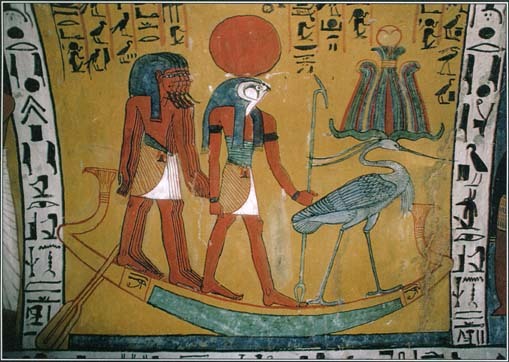
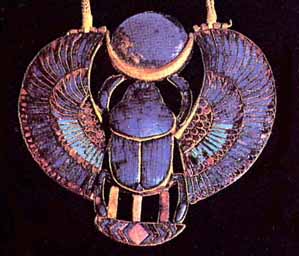
Ra (also spelled Re) dominates most of Egyptian religion as one of the primary deities throughout the span of the empire. Ra was the patron of the sun, heaven, Kingship of the pharaohs, power, and divine light. He is seen as one of the head gods as it is he who bestows power unto the pharaohs giving them the divine right to rule the Two Lands. Although not a contemporary view, E. A. Wallis Budge (1857-1934) claimed that Ra was the one god of Egyptian monotheism; from which all other deities were aspects, manifestations, phases, or forms.
Ra's physical appearance changed throughout the periods of ancient Egypt, however he is most often seen as a falcon headed pharaoh wearing the sun disk on his head. However, the easiest way to identify Ra is by the Sun disk over an item, generally speaking. Ra was worshiped as king of the gods (hence giving him the right to bestow Kingship) and the father of all creation. As the sun god, he commanded the chariot that rode across the sky during the day, with noon being of heightened importance. Like Osiris, Ra is the only other Egyptian god who is not on the earth. As an aging god, Ra is still powerful, yet too old to deal with his children any longer. This has caused him to go exclusively into the sky and watch over the world while his great-grandson, Horus, rules over the earth and the gods in his stead.
Acknowledged as the father of all, Ra had 4 children. However, as mythology changed so did Ra's wife or significant other. Early on Hathor was said to be Ra's wife, however, that changed into Hathor being Ra's daughter, then that Ra originally created Hathor as Sekhment (the fierce warrior lioness) as the Avenging Eye of Ra but then changed her into Hathor when his anger subsided. It is agreed that the following 4 are Ra's children: Nut (sky), - Shu, Tefnut, and Geb (Earth). Expanding the family, Nut and Geb created 4 children: Set, Osiris, Isis, and Nephthys. Isis and Osiris then had their only child Horus, who took over Ra's watch over earth. (Some accounts have Shu and Tefnut as Ra's only children, they in turn had Nut and Geb)

Over time Ra also became a composite deity with the Atum. Known as Ra-Atum or Atum-Ra they were a primordial creative force. In the form of Atum-Ra, Ra began to symbolized the setting sun and its journey through the underworld to its rising again in the east. He also is generally seen with the god Amun, creating Amun-Ra as the Hidden God/the Sun God.
----------------
Here is an Egyptian legend concerning Ra:
The Legend of Ra and Isis
Now Isis was a woman who possessed words of power; her heart was wearied with the millions of men, and she chose the millions of the gods, but she esteemed more highly the millions of the khu's. And she meditated in her heart, saying, "Cannot I by means of the sacred name of God make myself mistress of the earth and become a goddess like unto Ra in heaven and upon earth?"
Now, behold, each day Ra entered at the head of his holy mariners and established himself upon the throne of the two horizons. The holy one had grown old, he dribbled at the mouth, his spittle fell upon the earth, and his slobbering dropped upon the ground. And Isis kneaded it with earth in her hand, and formed thereof a sacred serpent in the form of a spear; she set it not upright before her face, but let it lie upon the ground in the path whereby the great god went forth, according to his heart's desire, into his double kingdom. Now the holy god arose, and the gods who followed him as though he were Pharaoh went with him; and he came forth according to his daily wont; and the sacred serpent bit him. The flame of life departed from him, and he who dwelt among the cedars was overcome. The holy god opened his mouth, and the cry of his majesty reached unto heaven. His company of gods said, "What hath happened?" and his gods exclaimed, "What is it?" But Ra could not answer, for his jaws trembled and all his members quaked; the poison spread swiftly through his flesh just as the Nile invadeth all his land.
When the great god had established his heart, he cried unto those who were in his train, saying, "Come unto me, O ye who have come into being from my body, ye gods who have come forth from me, make ye known unto Khepera that a dire calamity hath fallen upon me. My heart perceived it, but my eyes see it not; my hand hath not caused it, nor do I know who hath done this unto me. Never have I felt such pain, neither can sickness cause more woe than this. I am a prince, the son of a prince, a sacred essence which hath preceded from God. I am a great one, the son of a great one, and my father planned my name; I have multitudes of names and multitudes of forms, and my existence is in every god. I have been proclaimed by the heralds Tmu and Horus, and my father and my mother uttered my name; but it hath been hidden within me by him that begat me, who would not that the words of power of any seer should have dominion over me. I came forth to look upon that which I had made, I was passing through the world which I had created, when lo! something stung me, but what I know not. Is it fire? Is it water? My heart is on fire, my flesh quaketh, and trembling hath seized all my limbs. Let there be brought unto me the children of the gods with healing words and with lips that know, and with power which reacheth unto heaven." The children of every god came unto him in tears, Isis came with her healing words and with her mouth full of the breath of life, with her enchantments which destroy sickness, and with her words of power which make the dead to live. And she spake, saying, "What hath come to pass, O holy father? What hath happened? A serpent hath bitten thee, and a thing which thou hast created hath lifted up his head against thee. Verily it shall be cast forth by my healing words of power, and I will drive it away from before the sight of thy sunbeams."
The holy god opened his mouth and said, "I was passing along my path, and I was going through the two regions of my lands according to my heart's desire, to see that which I had created, when lo! I was bitten by a serpent which I saw not. Is it fire? Is it water? I am colder than water, I am hotter than fire. All my flesh sweateth, I quake, my eye hath no strength, I cannot see the sky, and the sweat rusheth to my face even as in the time of summer." Then said Isis unto Ra, "O tell me thy name, holy father, for whosoever shall be delivered by thy name shall live." [And Ra said], "I have made the heavens and the earth, I have ordered the mountains, I have created all that is above them, I have made the water, I have made to come into being the great and wide sea, I have made the 'Bull of his mother,' from whom spring the delights of love. I have made the heavens, I have stretched out the two horizons like a curtain, and I have placed the soul of the gods within them. I am he who, if he openeth his eyes, doth make the light, and, if he closeth them, darkness cometh into being. At his command the Nile riseth, and the gods know not his name. I have made the hours, I have created the days, I bring forward the festivals of the year, I create the Nile-flood. I make the fire of life, and I provide food in the houses. I am Khepera in the morning, I am Ra at noon, and I am Tmu at even." Meanwhile the poison was not taken away from his body, but it pierced deeper, and the great god could no longer walk.
Then said Isis unto Ra, "What thou hast said is not thy name. O tell it unto me, and the poison shall depart; for he shall live whose name shall be revealed." Now the poison burned like fire, and it was fiercer than the flame and the furnace, and the majesty of the god said, "I consent that Isis shall search into me, and that my name shall pass from me into her." Then the god hid himself from the gods, and his place in the boat of millions of years was empty. And when the time arrived for the heart of Ra to come forth, Isis spake unto her son Horus, saying, "The god hath bound himself by an oath to deliver up his two eyes" (i.e., the sun and moon). Thus was the name of the great god taken from him, and Isis, the lady of enchantments, said, "Depart, poison, go forth from Ra. O eye of Horus, go forth from the god, and shine outside his mouth. It is I who work, it is I who make to fall down upon the earth the vanquished poison; for the name of the great god hath been taken away from him. May Ra live! and may the poison die, may the poison die, and may Ra live!" These are the words of Isis, the great goddess, the queen of the gods, who knew Ra by his own name.

 Among the group of the most well known ancient Egyptians gods is Amun (also seen as Amen). He is the second largest god on record for the ancient Egyptians in his dual personality as Amun-Ra. Record of Amun is first seen in the early Pyramid Texts. Amun's attributes are sometimes in question, but are fairly understood to be the literal meaning of his name: The Essential and The Hidden. As a creator deity Amun was the champion of the poor and central to personal piety. Amun was self created and is not considered to be immanent within creation nor was creation seen as as an extension of himself. Amun's position as King of the Gods developed to the point of virtual monotheism were other gods became manifestations of him.
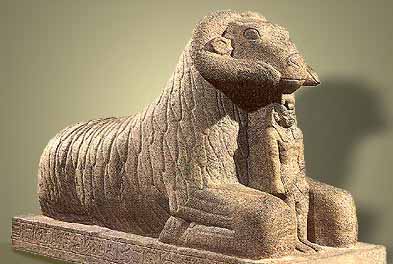 Hymns to Amun often read that he is "hidden to his children, "and "hidden to gods and men." In the later periods the name Amen appears to been connected with the root men - "to abide, to be permanent" - and one of the attributes applied to him was Eternal.