
 Among the group of the most well known ancient Egyptians gods is Amun (also seen as Amen). He is the second largest god on record for the ancient Egyptians in his dual personality as Amun-Ra. Record of Amun is first seen in the early Pyramid Texts. Amun's attributes are sometimes in question, but are fairly understood to be the literal meaning of his name: The Essential and The Hidden. As a creator deity Amun was the champion of the poor and central to personal piety. Amun was self created and is not considered to be immanent within creation nor was creation seen as as an extension of himself. Amun's position as King of the Gods developed to the point of virtual monotheism were other gods became manifestations of him.
Amun is seen as the breath of life, a creative force, and co-creator of the Ba. However, Amun did not engender the world/creation. The pharaohs attributed all their successful enterprises to Amun and they lavished their wealth and captured spoil on the construction of temples dedicated to Amun. It is the worship of Amun that Akhenaten banned (among other gods) and attempted to destroy during his reign as he believed the priests and the worship to have become corrupt. The cult of Amun-Ra became so powerful that its priesthood grew very large and influential, so that at one point, priests of the deity did actually rule Egypt during the 21st Dynasty. Amun while suppose to be sexless but is seen as the male aspect of the persona while Amunet is the female aspect. His consort is seen at Mut.
Amun was most often combined with the god, Ra. Seen as the dual god, Amun-Ra, he was believed to represented one of ancient Egypt's most complex theologies. Amun-Ra became a hidden, secret god as the Egyptians called him "the hidden one" or "the secret one." This dual personality is also known as the Sun God, the main aspect of Ra. Amun-Ra's name and physical appearance were the unknown, thus his unknowable essence. While suppose to be seperate versions of the god, Amun and Amun-Ra have in many ways become interchangeable.
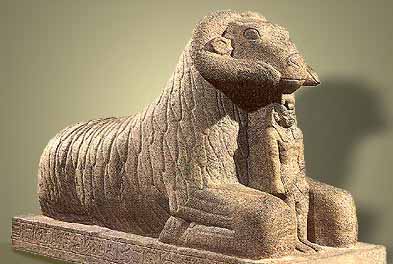 Hymns to Amun often read that he is "hidden to his children, "and "hidden to gods and men." In the later periods the name Amen appears to been connected with the root men - "to abide, to be permanent" - and one of the attributes applied to him was Eternal.
Amun is seen in five forms: 1) As a man, when he is seen seated on a throne, and holding in one hand the scepter, and in the other the symbol of "life." 2) As a man with the head of a frog, whilst his female counterpart Amunet has the head of a uraeus. 3) As a man with the head of a uraeus, whilst his female counterpart has the head of a cat. 4) As an ape. 5) As a lion couching upon a pedestal.


No comments:
Post a Comment