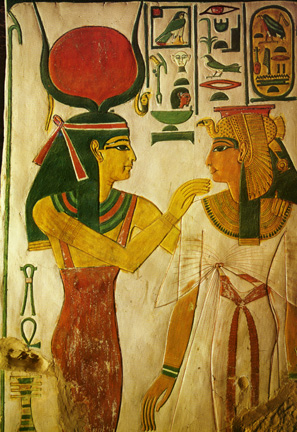
 Hathor (meaning, "The House of Horus") was known to the Ancient Egyptians as the goddess of the sky, the sun, music, dance and the arts. She was often symbolized as a cow bearing the sun disk between her horn and a woman in queenly raiment wearing the sun disk and horns on her head. Dating back to the predynastic time, Hathor is one of the, if not the, oldest goddess for the Egyptians. She was originally associated with the pharaoh as his queen. Hathor became the incarnation of dance and one of Inspiration. Worship of Hathor had her male and female priests dancing in rituals and people flocking to have their dreams explained.
Hathor was originally a personification of the Milky Way, which was considered to be the milk that flowed from the udders of a heavenly cow. It was throughout the ages that Hathor took on her other characteristics, some that overshadowded others, and other identities and forms. She is almost a confusing goddess. As an ancient goddess the Egyptians attempted to keep her throughout the periods but added or took away from her. Thus her marriages, children, names, and characteristics vary according to period. Here we'll just discuss the few the prevailed most often.
 Hathor is also Mehturt (for about 3,000 years), meaning great flood. This aspect of Hathor had the Egyptians identifying her as responsible for the yearly inundation of the Nile. Being recognized as responsible for the flooding of the Nile also had Hathor seen as a herald of imminent birth (when the amniotic sac breaks it is an indicator that the child is due to be born). This eventually expanded to Hathor being a goddess of fertility.
For a short time Hathor was associated with Sekhmet (a war goddess) as Sekhmet-Hathor. Due to their similar physical associations they were combined to create the lioness goddess. One version claims this story: as the Eye of Ra - defender of the sun god - Hathor was sent out to punish the people (in the form of Sekhmet). She slaughtered people by the hundreds and Ra relented seeing the utter destruction and commanded her to stop. Sekhment refused as she was blood thirsty. To stop the slaughter, bear was colored red (to resemble blood) and poured over the killing fields. When Sekhmet drank the beer, she became drunk and drowsy, and slept for three days. When she awoke she had no taste for human flesh and mankind was saved. From then on she was renamed her Hathor. As a result, soldiers also prayed to Hathor/Sekhmet to give them her strength and focus in battle.
Hathor was the mother of Horus and wife of Ra. Although as Egyptian mythology continued she was said to be married to Thoth, as Ra and Atum were the same deity, making it complicated for her to be wife to her son whom she created. As wife of Ra, Hathor held the title Mistress of Heaven and the Eye of Ra. She is also later said to be Hathor's wife. In reality, she was probably meant to have just been combined with the original wives of the gods creating a stronger deity, not replacing the wives of old.