
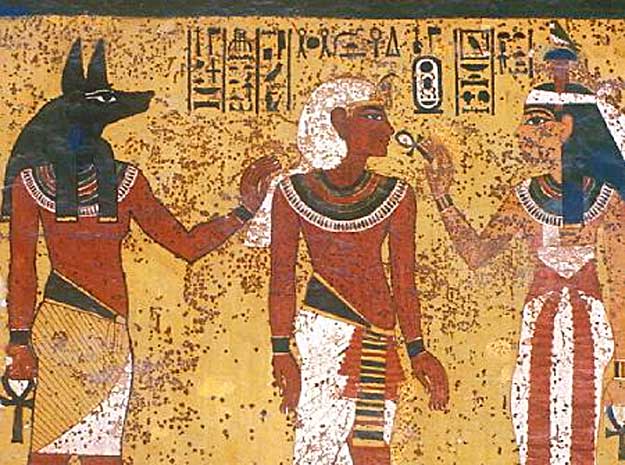
 Seen everywhere the Egyptians painted, the ankh is a symbol representing everlasting life but was always coupled with death as well. The ankh has a myriad of meanings including representing zest, joy of life, and energy. With symbolizing life, the ankh also becomes associated with fertility and is portrayed with all the gods and pharaohs. While an exact definition is impossible to pin down for the ankh, a general sense of the use of the ankh is much easier to discern.
The origins of the ankh are still unknown and widely debated. But its meaning is general and its uses wide. Due to such a lose set of terms used for the ankh being able reason is a big way of figuring out the usage of the ankh in a certain situation when deciphering Egyptian texts and paintings.
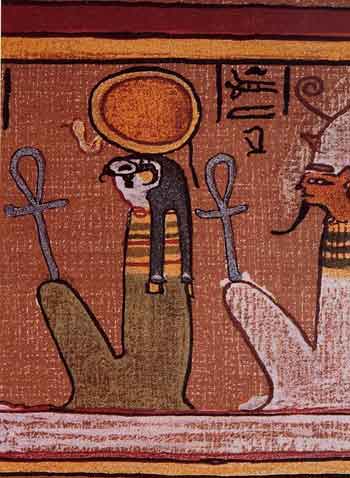
To the Egyptians the ankh stood for the word Ê¿ná, meaning life. It is also called crux ansata, Latin for cross-with-a-handle. The ankh was typically carried by Egyptians as an amulet, often alone or in connection with two other hieroglyphs the Djed and Was that mean "strength" and "health." The gods would be seen carrying the ankh by its loop or bearing one in each hand with arms crossed over their chest.
The ankh, on some temple walls in Upper Egypt, could also symbolize water in rituals of purification. Here, the king would stand between two gods, one of whom was usually Thoth, as they poured over him a stream of libations represented by ankhs.
Most noticeably used with the ankh is Hathor, the mother goddess of life and of death. With the ankh Hathor can give life and she is seen doing such countless times within Egyptian texts and paintings. However, other ancient gods of Egypt are depicted carrying an ankh. Anqet, Ptah, Satet, Sobek, Tefnut, Osiris, Ra, Isis, and Anibus are among the many other gods often holding the ankh along with a scepter. In various tomb and temple reliefs the ankh is placed in front of the pharaoh to symbolize the breath of eternal life. Used to show divine rights, the ankh during the Amarna period was depicted as being offered to Akhenaten and Nefertiti by the hands at the end of the rays descending from the sun disk, Aten. This also showed that the ankh not only represented the life here on earth, but that of the netherworld by such an offering from the gods. With the gods offering the ankh for any man or woman, pha
As a hieroglyph the ankh is known as the key of the Nile and was associated with Imkotep (~3000 B.C.) who was physician for the Pharaoh's family. After Imkotep's death he was eventually made the god of medicine and of healing throughout Egypt. This is why the Ankh is also used is a pharmaceutical manner in Egyptian records.


No comments:
Post a Comment