Isis is the ancient Egyptians' goddess of fertility and motherhood. Isis literally means: female of throne (i.e. Queen of the throne). Her original headdress was an empty throne chair belonging to Osiris, her murdered husband. As Isis was the personification of the throne, she was an important source of the Pharaoh's power.
Noted in the Book of the Dead, Isis is said to be she who gives birth to heaven and earth, knows the orphan, knows the widow, seeks justice for the poor, and shelter for the weak. Amoung Isis' seemingly endless titles are: Queen of Heaven, Mother of the Gods, The One Who is All, Lady of Green Crops, The Brilliant One in the Sky, Great Lady of Magic, Mistress of the House of Life, She Who Knows How To Make Right Use of the Heart, Light-Giver of Heaven, Lady of the Words of Power, and Moon Shining Over the Sea.
In the heaven's Isis is the star Sept (Sirius). Sept marks the beginning of a new year and announces the Inundation of the Nile. Isis held numerous positions with numerous names. A few include being light-giver at this season of the year called Khut, the mighty earth-goddess Usert, the Great Goddess of the Underworld Thenenet, the power which shot forth the Nile flood Sati and Sept, the embracer of the land and producer of fertility by her waters Anqet, the producer and giver of life Ankhet, the goddess of cultivated lands and fields Sekhet, and the goddess of the harvest Renenet.
 Isis' husband, Osiris, was lord of the Underworld, and as such Isis was the great lady of the Underworld. In this capacity she assisted in transforming the bodies of the blessed dead into those wherein they were to live in the realm of Osiris. Readers often remember the duo of Isis and Osiris as it was Osiris that was killed by his brother Set. Isis resurrected him and became pregnant, but Set cut Osiris into numerous pieces scattering them throughout the land. Osiris then entered the Underworld and became the rightful ruler.
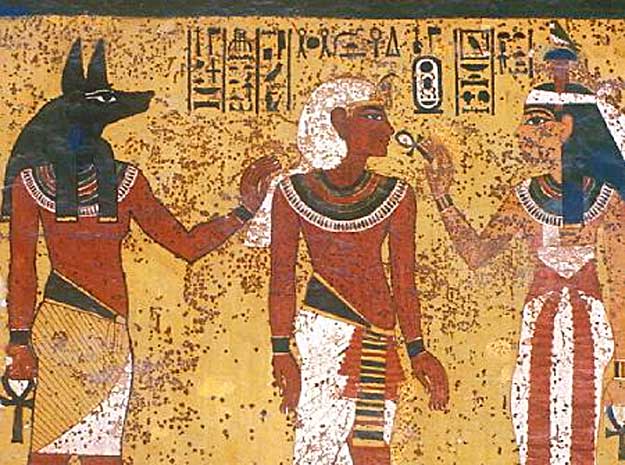
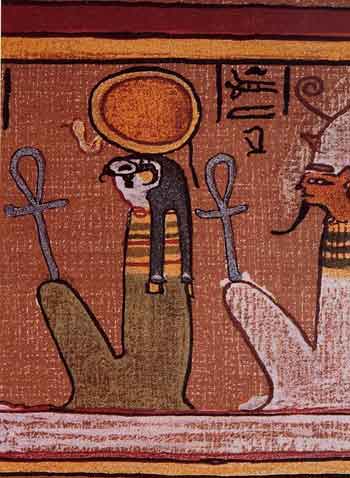
Isis is portrayed as a woman wearing a long sheath dress and crowned with the hieroglyphic sign for a seat, sometimes holding a lotus, and sometimes as a sycamore tree. After Isis assimilated Hathor, Isis' headdress was replaced with that of Hathor: the horns of a cow on her head, and the solar disc between them. Isis is generally depicted with her son, Horus, with a crown and a vulture, and sometimes as a kite bird flying above Osiris's body. She often holds the ankh.