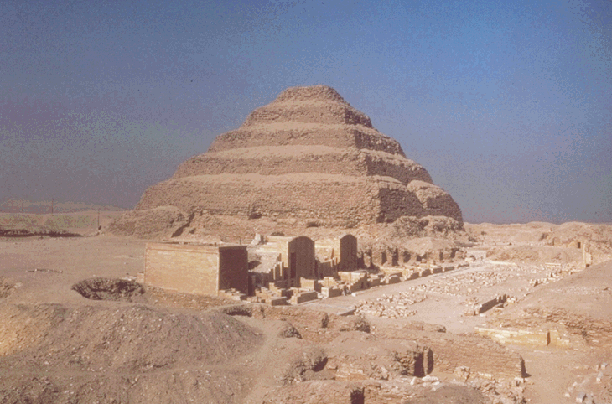
Imhotep, "the one that comes in peace," served under the 3rd dynasty pharaoh Djoser. At the beginning of modern history Imhotep existed as a mythological figure in the minds of most scholars until 1900's when he was established as a real historical entity. He was chancellor to Djoser and high priest of the sun god Ra at Heliopolis. He is considered to be the first engineer, architect, and physician in history known by name. The full list of Imhotep's titles were as follows: Chancellor of the King of Egypt, Doctor, First in line after the King of Upper Egypt, Administrator of the Great Palace, Hereditary nobleman, High Priest of Heliopolis, Builder, Chief Carpenter, Chief Sculptor and Maker of Vases in Chief.
Imhotep's historicity is confirmed by two inscriptions made during his lifetime: 1) on the base of one of Djoser's statues (CairoJE 49889) and 2) by a graffito on the enclosure wall surrounding Sekhemkhet's unfinished step-pyramid. The latter inscription suggests that Imhotep possibly outlived Djoser by several years and in all reason went on to serve in the construction of king Sekhemkhet's pyramid (which happened to be abandoned due to his short reign).
Family
 Imhotep was a commoner by birth. However, his intelligence and determination enabled him to rise through his low status to become one of Djoser's most trusted advisers, as well as the architect of the Djoser's tomb, the Step Pyramid. The month and day of his birth are noted as the sixteenth day of Epiphi, third month of the Egyptian harvest (corresponding to May 31) but historians vary on whether or not this accepted. Imhotep may have been born in Ankhtowë, a suburb of Memphis in early Egypt yet other classical writers suggest that he was from the village of Gebelein, south of Thebes. His father is believed to have been an architect named Kanofer and his mother Khreduonkh (who is assumed belonged to the province of Mendes). Historians believe that his wife's name was Ronfrenofert.
In myth Imhotep's mother was a mortal named Kheredu-ankh who was later elevated to semi-divine status by claims that she was the daughter of Banebdjedet. Imhotep as the "Son of Ptah" had his mother sometimes claiming to be Sekhmet, the patron of Upper Egypt who was often said to be married to Ptah.
Impacts
 During his lifetime Imhotep was one of the officials of the Pharaoh. Djoser. As such he designed the Pyramid of Djoser, also known interchangeably as the Step Pyramid, at Saqqara, Egypt. As an architect he is believed to been responsible for the first known use of columns in architecture. The historian Manetho credits Imhotep with inventing the method of a stone-dressed building during Djoser's reign even though he was not the first to build with stone. Before Imhotep pharaoh were still reduced to the simple looking mastabas.
Among Imhotep's credentials is being the founder of Egyptian medicine and the author of a medical treatise remarkable for being devoid of magical thinking. His so-called Edwin Smith papyrus contained anatomical observations, ailments, and cures with the oldest surviving papyrus copy written around 1700 BC (however, this may be a copy of texts a thousand years older).
About 100 years after Imhotep's death, he was elevated as a medical demigod. However, around 2,000 years after his death, he given the elevation to a full god and replaced Nefertum in the great triad at Memphis. Imhotep one of the very few mortals that ever reached the position of full gods. Imhotep is also associated with Thoth, the god of wisdom, writing and learning, and with the Ibises.
Death