
 The period following the Early Dynastic Period is one of the most well known of all Egyptian history. Sporting some of the most memorable pharaohs, achievements, and defining highlights of all Egyptian culture most people can recognize the Old Kingdom Period. Comprised of the 3rd-6th dynasties the Old Kingdom Period brings the rise of the great pyramids.
During the Old Kingdom Period, also known as the Age of the Pyramids, capital was located in Memphis. During this time names that have not been gotten first appear: Djoser (who had the step pyramid built), Imhotep (Djoser's advisor), and a host of others. During this time pharaoh became universally deified and the people worshiped their pharaoh as a god, believing that he ensured the annual flooding of the Nile that dictated their lives.
The Old Kingdom Period was one of the richest and most creative period in Egyptian history. With all of Egypt's pyramids built at this time - the growth in population and wealth allowed the pharaohs to afford the vast amounts of labor and materials to these monuments to, themselves.
Djoser's pyramid, called the Step Pyramid, has world wide recognitio
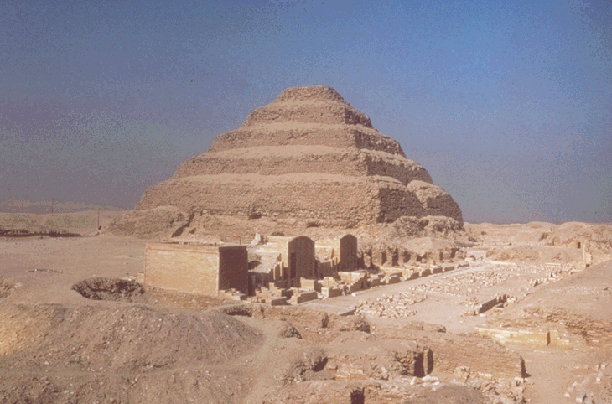 n. A series of 6 bases, or mastabas built on top of one another it is the beginning of the revolution of the pyramids. Unlike the Great Pyramid of Giza the sides were not smooth but it was a start to the classical Egyptian pyramid. (Seen here on the right is Djoser's Step Pyramid and complex)
In the Fourth Dynasty Snofru built for himself 3 pyramids. With a greater m
 ass of stones than any other pharaoh, he built the now collapsed pyramid in Meidum, the Bent Pyramid at Dahshur, and the Red Pyramid at North Dahshur. Now for the one of the most famous pharaohs in history, Khufu. The builder of the Great Pyramid of Giza some later Egyptian literature describes him as a cruel tyrant, who imposed forced labor on his subjects to complete his pyramid. (Seen here on the left is the Great Pyramid of Giza along with the two smaller pyramids later built by Khafre/Chephren and Menkaure/Mycerinus)
From the Fourth Dynasty on the administration of the country was highly organized and controlled by civil servants from the royal residence at Memphis, where the pharaoh god reigned supreme. The efficiency of the administration is seen in the building of the pyramids. Estimated that the Great Pyramid of Giza when complete contained about 2,300,000 blocks of stone ( of an average weight of 2½ tons), all of which had to be transported from quarry to site, there is no better example of such an administration.
3rd Dynasty Rulers
Sanakhte (Nebka) | 2650 - 2630 BC
Netjerykhet (Djoser) | 2630 - 2611 BC
Sekhemkhet (Djoser Teti) | 2611 - 2603 BC
Khaba | 2603 - 2599 BC
Huni | 2599 - 2575 BC
4th Dynasty Rulers
Snefru | 2575 - 2551 BC
Khufu (Cheops) | 2551 - 2528 BC
Djedefre | 2528 - 2520 BC
Khafre (Chephren) | 2520 - 2494 BC
Menkaure (Mycerinus) | 2490 - 2472 BC
Shepseskaf | 2472 - 2467 BC
5th Dynasty Rulers
Userkaf | 2465 - 2458 BC
Sahure | 2458 - 2446 BC
Neferirkare Kakai | 2477-2467 BC
Shepseskare Ini | 2426 - 2419 BC
Neferefre | 2419 - 2416 BC
Niuserre Izi | 2453 - 2422 BC
Menkauhor | 2422 - 2414 BC
Djedkare Izezi | 2388 - 2356 BC
Unas | 2375-2345 BC
6th Dynasty Rulers
Teti | 2345 - 2333 BC
Pepy I (Meryre) | 2332 - 2283 BC
Merenre Nemtyemzaf | 2283 2278 BC
Pepy II (Neferkare) | 2278 - 2184 BC


