Showing posts with label King Narmer. Show all posts

06 May 2009

Early Dynastic Period

The Early Dynastic Period of Egypt quickly followed the unification of Upper and Lower Egypt by the legendary Pharaoh Menes, also believed to be King Narmer. The Early Dynastic Period includes the 1st and 2nd Dynasties which ended about 2686 BC which marks the beginning of the Old Kingdom. The First Dynasty saw the capital of a unified Egypt moved from Abydos to Memphis and an Egyptian king thought to be a god. The whole of Egypt extended from the lush Nile Delta to the first cataract at Aswan bordering the Nubians. However, Abydos did not lose prominence and still remained the center of cult worship in Upper Egypt. The Early Dynastic Period marks the beginning of what people generally know of as Egypt.

Since Egypt had primarily been a country of two states, Upper and Lower, the name the Two Lands, was used in description of Egypt and its people. At the beginning of the Early Dynastic Period the pharaohs established a national administration, appointed royal governors, and pushed for the advancement of architecture. Buildings predominately were open-air and constructed of wood or the growing in popularity sandstone. Structures originally built in brick, wood, and reeds were copied in stone, giving birth to the typical ancient Egyptian architecture. Assimilation included a single spoken language with varying dialects and common hieroglyphs. During this period Egyptians began construction of the mastabas which were "simple" dirt, wood, or stone mounds covering the dead. These led to the soon to be seen step pyramids. The Egyptians also continued to master agriculture and the cycles of the Nile and their civilization quickly rose to prominence. Another change of note is the rise of urbanism as people migrated to larger city like communities.

Authorities vary on who was the first pharaoh of the Early Dynastic Period. Some start with Menes and others start with Hor-Aha. Narmer was the first ruler to claim to have united Upper and Lower Egypt, but he is also believed by many experts to be Menes himself. Others see that Egypt was unified not because of armies but because of cultural and economic reasons long before its first king ascended to the throne in Upper Egypt. Political unification would have been gradual as local districts established trading networks and organized agriculture labor on a larger scale which would have pushed divine kingship into momentum.

One of the most important tools used in deciphering some of the first ancient Egyptian kings is the Palermo Stone. A fragment of a 5th century basalt stele it details information on cult ceremonies, taxation, sculpture, buildings, warfare, along with a kings list the Palermo stone has been essential in revealing most of the rulers in the early dynasties. The Palermo Stone is now seen as Egypt's oldest history book. (The Palermo Stone is seen here to the right)

1st Dynasty Rulers

-Narmer (Menes?) | c. 3100–3050 BC

-Hor-Aha | c. 3050–3049 BC

-Djer | c. 3049–3008 BC

-Merneith (mother of Den) |less than a year

-Djet | c. 3008–2975? BC

-Den | c. 2975–2935? BC

-Anebjib | c. 2935–2925? BC (known to have reigned 10 years according to the Palermo Stone)

-Semerkhet | c. 2925–2916? BC (known to have reigned 9 years according to the Palermo Stone)

-Qa'a | c. 2916?–2890 BC

2nd Dynasty Rulers

-Hotepsekhemwy | 2890-2852 BC

-Raneb | 2852-2813 BC

-Nynetjer | 2813-2766 BC

-Weneg | 2766-2758 BC (not sure to have existed, believed to be Raneb)

-Sened | 2758-2738 BC

-Peribsen | 2738-2716 BC

-Khasekhemwy | 2716-2686 BC

05 May 2009

Protodynastic Egypt

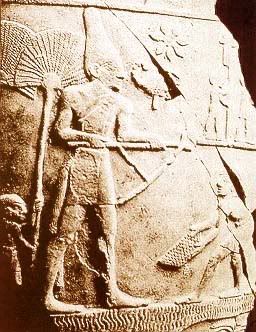
Separated now from the Predynastic Period of Egypt, the Protodynastic Period is that end and beginning of two very individual sets of civilizations. The time frame for the Protodynastic Period is ~3300-3000 BC. (Photo to left is a piece of pottery showing the Scorpion King that we now have the legends and movies of.)

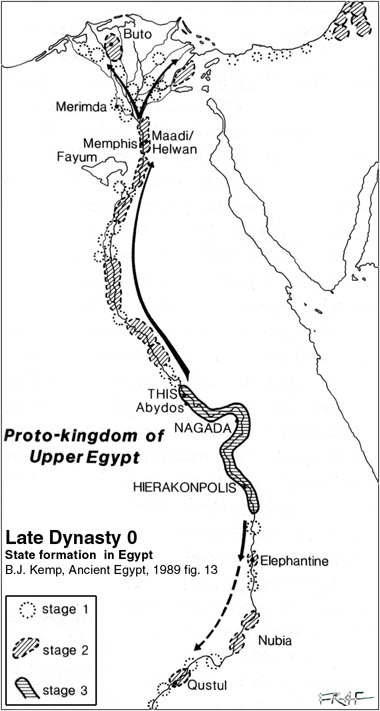
The Protodynastic Period is hard to label as it was the time when Egypt was undergoing the process of political unification, leading to a unified state during the Early Dynastic Period. It was also during the Protodynastic Period that the Egyptian language first was recorded using hieroglyphs. With unification came a beginning to state formation and numerous small city-states arose along the Nile. Conquests reduced Upper Egypt to three states:Thinis, Naqada, and Nekhen. Little is known of Lower Egypt's political unification but that they may have shared in Naqada's Set cult while Thinis and Nekhen were part of the Horus cult. As the conquering continued Naqada fell first as it sat sandwiched by Thinis and Nekhen. Thinis arose and then conquered Lower Egypt, uniting the numerous states and tribes. Experts still do not agree on how Thinis and Nekhen united, but it appears they merged peacefully to create the royal family ruling all of Egypt.

The Protodynastic Period is considered by most Egyptologists to have ended with King Narmer, although some still place him in the First Dynasty starting the Early Dynastic Period. The Scorpion King (although there were several by that name) is believed to have been towards the end of the Protodynastic Period as well. Seen here to the right is the palette of King Narmer c. 3000 BC.

See here & here for more Protodynastic Period intense information.

Protodynastic Period/Dynasty 0 Rulers

(c. 3300 BC)

-Scorpion I

-Anonymous Serekhs

-Double Falcon

-Ny-Hor

-Pe-Hor

-Hat-Hor

-Hedj-Hor; (Iry-Hor)

(c. 3150-3000)

-Scorpion (II)

-Iry Hor

-Ka

-Narmer

Predynastic Egypt

The Predynastic Period of Egypt (prior to ~3100 BC) is the time period between the early Neolithic and the beginning of the pharaonic monarchy beginning with King Narmer. However, the 3100 BC is an approximate date of the Predynastic Period ending due to the vast archaeological excavation in Egypt taking place revealing recent finds which show that the Predynastic Period progressed slowly. So now debates have scholars arguing about when exactly the Predynastic Period ended due to the more moderate advancement of civilization by the collective Egyptians. This argument and others like have brought about the term Protodynastic Period, which is also referred to as Dynasty 0. The Protodynastic Period is used to characterize the time in limbo which has some scholars labeling it predynastic and others dynastic. In other words, it made a middle ground to stop the arguing.

Labeling of the Predynastic Period is done by cultures inhabiting Lower and Upper Egypt. The Predynastic Period begins with the southern cultures, like the Badarian, who were almost completely agrarian, and their northern counterparts, such as the Faiyum, who were oasis dwellers and still relied on hunting and fishing for the majority of their diet. Stone working, particularly that involved in the making of blades and points and furniture quickly reached a level almost that of the Old Kingdom would follow. Coming out of the Neolithic age their objects not only had a function but also an aesthetic value. Pottery became decorated - particularly the black-topped clay pots and vases that the era became noted for. Bone and ivory combs, figurines, tableware, and jewelry of all types and materials became abundant. While the rest of the world still slumbered in Paleolithic and Neolithic times, Egyptians were forging ahead.

The Predynastic Period then progressed to the Amratian period, or Naqada I. Here the pottery originally was decorated with simple bands of paint, but now they were adorned with clever geometric designs inspired by the world. Now pictures of animals were painted or carved into the pottery as well. Pottery shapes changed for practical and aesthetic reasons. Now the popular "dancer" figurines, small painted figures of women with upraised arms, hit the scene. However, the most important detail of this period is the development of architecture. With Egypt we have found that most of our knowledge comes from what the deceased were buried with and this case is no exception. From predynastic graves we find clay models of houses that resemble the rectangular clay brick homes of the Old Kingdom. This tells us that the idea of individual dwellings, towns, and urban planning started ~4500 BC.

The third stage of the Predynastic period known as the Gerzean period or Naqada II. The greatest difference people of Upper and Lower Egypt is seen in their ceramics. While Amratian pottery had some decorative aspects, its primary purpose was functional. Gerzean pottery, however, was developed more for decorative uses. Adorned with geometric motifs, highly realistic depictions of animals, and people Gerzean pottery surpasses all previous ceramic advancements. Their depictions of ostriches and ibexes may be a clue that the Gerzeans hunted in the sub-desert, as ostriches and ibexes are not found near the Nile. Here we first also find what could be first representations of gods. However, it is also possible that these are simply some form of historical records. Compared to the later periods, the Gerzean culture varies only slightly especially in is religious context and funerary customs. Tomb building was lavish with furnished underground rooms that were near replicas of the dwelling that the deceased had occupied in life. Yet the Amratian burials were simply a pit in the ground covered over by a skin-covered framework.

See here more for Predynastic intense information.