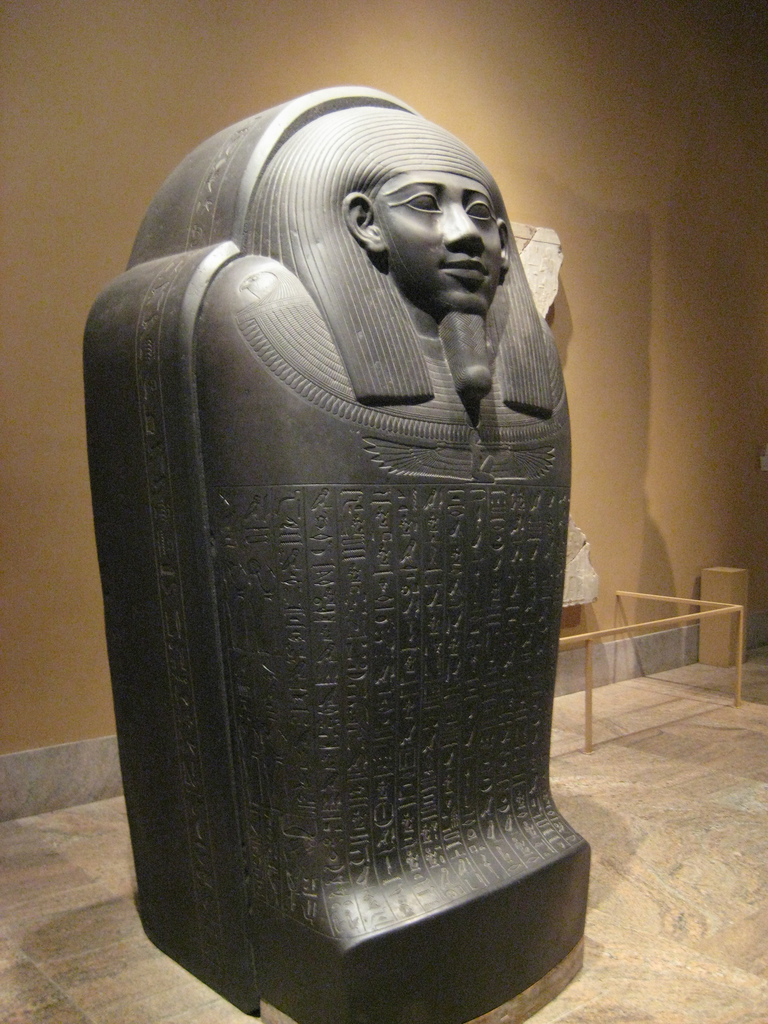
The end of the Late Period in Egypt brought in the age of the Ptolemaic Dynasty/Period. It was in 332 BC that Alexander III "the Great" of Macedon conquered Egypt with little resistance from the Persians. Egyptians welcomed him as deliverer and god. Alexander in turn visited Memphisand went on pilgrimage to the oracle of Amun at the Oasis of Siwa. There the oracle declared him to be the son of Amun-Re. Alexander earned favor with the Egyptians by respecting and slightly being involved in Egyptian rituals and religion. Alexander founded a new Greek city in Egypt named Alexandria. It is this city that became a major commercial port, where Alexander was buried, and that quickly became Egypt's administrative capital and an intellectual centre.
Ptolemaic Egypt began however when Ptolemy I Soter declared himself Pharaoh of Egypt in 305 BC and the dynasty ended with the death of the infamous Cleopatra VII of Egypt during the Roman conquest in 30 BC. The Ptolemaic Period was a powerful Hellenistic state, extending from southern Syria, to Cyrene, and to the frontier with Nubia. The Ptolemies to gain recognition by the native Egyptian populace nam
 ed themselves as their successors did before them - pharaohs. Later on in the dynasty the Ptolemies took on Egyptian traditions and had themselves portrayed on public monuments in Egyptian style and dress, and participated in Egyptian religious life. Yet all of this did not appease all Egyptians, the Ptolemies still faced rebellions often caused by an unwanted regime and were involved in foreign and civil wars that led to the decline of the Ptolemaic dynasty and its eventual annexation by Rome.
The uniquenes
The rulers of the Ptolemaic Period had certain characteristics which make them stand out. All of the male rulers took the name Ptolemy while the queens were usually called Cleopatra. The most famous member the queens of the Ptolemies was the last queen, Cleopatra VII, known for her role in the Roman political battles between Julius Caesar and Pompey and with Octavian and Mark Antony. Her suicide during the conquest by Rome was the end of Ptolemaic rule in Egypt and the end of Egypt as she was known.
Ptolemaic Dynasty Rulers
Ptolemy I Soter | c. 305-282 BCPtolemy II Philadelphus | c. 284-246 BC
Ptolemy III Euergetes | c. 246-222 BC
Ptolemy IV Philopator | c. 222-204 BC
Ptolemy V Epiphanes | c. 204-180 BC
Ptolemy VI Philometor | c. 180-164 BC & 163-145 BC
Ptolemy VIII Euergetes II (Physcon) | c. 170-163 BC & 145-116 BC
Cleopatra II Philometora Soteira | c. 131-127 BC
Cleopatra III Philometor Soteira Dikaiosyne Nikephoros (Kokke) | c. 116-101 BC
Ptolemy IX Soter II (Lathyros) | c. 116-107 BC & 88-81 BC
Ptolemy X Alexander I | c. 107-88 BC
Berenice III Philopator | c. 81-80 BC
Ptolemy XI Alexander II | c. 80 BC
Ptolemy XII Neos Dionysos (Auletes) | c. 80-58 BC & 55-51 BC
Cleopatra V Tryphaena | c. 58-57 BC
Cleopatra VII Philopator | c. 51-30 BC
Arsinoe IV | c. 48-47 BC