15 November 2009

Isis

IsisIsis is the ancient Egyptians' goddess of fertility and motherhood. Isis literally means: female of throne (i.e. Queen of the throne). Her original headdress was an empty throne chair belonging to Osiris, her murdered husband. As Isis was the personification of the throne, she was an important source of the Pharaoh's power.

Noted in the Book of the Dead, Isis is said to be she who gives birth to heaven and earth, knows the orphan, knows the widow, seeks justice for the poor, and shelter for the weak. Amoung Isis' seemingly endless titles are: Queen of Heaven, Mother of the Gods, The One Who is All, Lady of Green Crops, The Brilliant One in the Sky, Great Lady of Magic, Mistress of the House of Life, She Who Knows How To Make Right Use of the Heart, Light-Giver of Heaven, Lady of the Words of Power, and Moon Shining Over the Sea.

In the heaven's Isis is the star Sept (Sirius). Sept marks the beginning of a new year and announces the Inundation of the Nile. Isis held numerous positions with numerous names. A few include being light-giver at this season of the year called Khut, the mighty earth-goddess Usert, the Great Goddess of the Underworld Thenenet, the power which shot forth the Nile flood Sati and Sept, the embracer of the land and producer of fertility by her waters Anqet, the producer and giver of life Ankhet, the goddess of cultivated lands and fields Sekhet, and the goddess of the harvest Renenet.

IsisIsis' husband, Osiris, was lord of the Underworld, and as such Isis was the great lady of the Underworld. In this capacity she assisted in transforming the bodies of the blessed dead into those wherein they were to live in the realm of Osiris. Readers often remember the duo of Isis and Osiris as it was Osiris that was killed by his brother Set. Isis resurrected him and became pregnant, but Set cut Osiris into numerous pieces scattering them throughout the land. Osiris then entered the Underworld and became the rightful ruler.

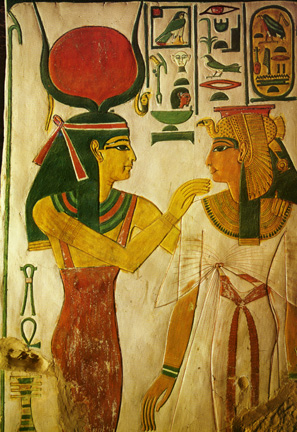
Isis is portrayed as a woman wearing a long sheath dress and crowned with the hieroglyphic sign for a seat, sometimes holding a lotus, and sometimes as a sycamore tree. After Isis assimilated Hathor, Isis' headdress was replaced with that of Hathor: the horns of a cow on her head, and the solar disc between them. Isis is generally depicted with her son, Horus, with a crown and a vulture, and sometimes as a kite bird flying above Osiris's body. She often holds the ankh.

12 November 2009

Hathor

HathorHathor (meaning, "The House of Horus") was known to the Ancient Egyptians as the goddess of the sky, the sun, music, dance and the arts. She was often symbolized as a cow bearing the sun disk between her horn and a woman in queenly raiment wearing the sun disk and horns on her head. Dating back to the predynastic time, Hathor is one of the, if not the, oldest goddess for the Egyptians. She was originally associated with the pharaoh as his queen. Hathor became the incarnation of dance and one of Inspiration. Worship of Hathor had her male and female priests dancing in rituals and people flocking to have their dreams explained.

Hathor was originally a personification of the Milky Way, which was considered to be the milk that flowed from the udders of a heavenly cow. It was throughout the ages that Hathor took on her other characteristics, some that overshadowded others, and other identities and forms. She is almost a confusing goddess. As an ancient goddess the Egyptians attempted to keep her throughout the periods but added or took away from her. Thus her marriages, children, names, and characteristics vary according to period. Here we'll just discuss the few the prevailed most often.

HathorHathor is also Mehturt (for about 3,000 years), meaning great flood. This aspect of Hathor had the Egyptians identifying her as responsible for the yearly inundation of the Nile. Being recognized as responsible for the flooding of the Nile also had Hathor seen as a herald of imminent birth (when the amniotic sac breaks it is an indicator that the child is due to be born). This eventually expanded to Hathor being a goddess of fertility.

For a short time Hathor was associated with Sekhmet (a war goddess) as Sekhmet-Hathor. Due to their similar physical associations they were combined to create the lioness goddess. One version claims this story: as the Eye of Ra - defender of the sun god - Hathor was sent out to punish the people (in the form of Sekhmet). She slaughtered people by the hundreds and Ra relented seeing the utter destruction and commanded her to stop. Sekhment refused as she was blood thirsty. To stop the slaughter, bear was colored red (to resemble blood) and poured over the killing fields. When Sekhmet drank the beer, she became drunk and drowsy, and slept for three days. When she awoke she had no taste for human flesh and mankind was saved. From then on she was renamed her Hathor. As a result, soldiers also prayed to Hathor/Sekhmet to give them her strength and focus in battle.

Hathor was the mother of Horus and wife of Ra. Although as Egyptian mythology continued she was said to be married to Thoth, as Ra and Atum were the same deity, making it complicated for her to be wife to her son whom she created. As wife of Ra, Hathor held the title Mistress of Heaven and the Eye of Ra. She is also later said to be Hathor's wife. In reality, she was probably meant to have just been combined with the original wives of the gods creating a stronger deity, not replacing the wives of old.

08 November 2009

Amun/Amen

Among the group of the most well known ancient Egyptians gods is Amun (also seen as Amen). He is the second largest god on record for the ancient Egyptians in his dual personality as Amun-Ra. Record of Amun is first seen in the early Pyramid Texts. Amun's attributes are sometimes in question, but are fairly understood to be the literal meaning of his name: The Essential and The Hidden. As a creator deity Amun was the champion of the poor and central to personal piety. Amun was self created and is not considered to be immanent within creation nor was creation seen as as an extension of himself. Amun's position as King of the Gods developed to the point of virtual monotheism were other gods became manifestations of him.

Amun is seen as the breath of life, a creative force, and co-creator of the Ba. However, Amun did not engender the world/creation. The pharaohs attributed all their successful enterprises to Amun and they lavished their wealth and captured spoil on the construction of temples dedicated to Amun. It is the worship of Amun that Akhenaten banned (among other gods) and attempted to destroy during his reign as he believed the priests and the worship to have become corrupt. The cult of Amun-Ra became so powerful that its priesthood grew very large and influential, so that at one point, priests of the deity did actually rule Egypt during the 21st Dynasty. Amun while suppose to be sexless but is seen as the male aspect of the persona while Amunet is the female aspect. His consort is seen at Mut.

Amun was most often combined with the god, Ra. Seen as the dual god, Amun-Ra, he was believed to represented one of ancient Egypt's most complex theologies. Amun-Ra became a hidden, secret god as the Egyptians called him "the hidden one" or "the secret one." This dual personality is also known as the Sun God, the main aspect of Ra. Amun-Ra's name and physical appearance were the unknown, thus his unknowable essence. While suppose to be seperate versions of the god, Amun and Amun-Ra have in many ways become interchangeable.

Hymns to Amun often read that he is "hidden to his children, "and "hidden to gods and men." In the later periods the name Amen appears to been connected with the root men - "to abide, to be permanent" - and one of the attributes applied to him was Eternal.

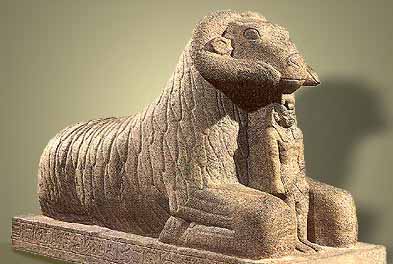
Amun is seen in five forms: 1) As a man, when he is seen seated on a throne, and holding in one hand the scepter, and in the other the symbol of "life." 2) As a man with the head of a frog, whilst his female counterpart Amunet has the head of a uraeus. 3) As a man with the head of a uraeus, whilst his female counterpart has the head of a cat. 4) As an ape. 5) As a lion couching upon a pedestal.